Brag Document: Template and How to Keep One
What a brag document is and why it works, a copyable Markdown brag doc template with a worked example, how often to update it, and how to turn it into a self-evaluation or promotion case.


What a brag document is and why it works, a copyable Markdown brag doc template with a worked example, how often to update it, and how to turn it into a self-evaluation or promotion case.
Three copy-paste daily report templates (an EOD report, a project progress report and a two-line Slack version), a filled-in example day, how to write one in five minutes and when daily reports become micromanagement.
A step-by-step method for writing a self-evaluation: gather the year's evidence first, follow the review form, write accomplishments as outcomes, name growth areas and goals, plus phrasing do's and don'ts and how managers read it.
Self-evaluation examples organized by skill and by role (engineer, product manager, designer, sales, support, manager), each with a weak and a strong version, plus improvement comments and a full sample.
Copy-and-adapt self-evaluation examples for each section a performance review form asks for: accomplishments, goals met and missed, competencies, growth, next-period goals and manager comments, plus a filled-in sample.
What a standup meeting is, a 15-minute agenda with timeboxes, better formats than the three questions, facilitation rules, remote and time-zone setups, an async standup template, and what a standup costs.
What a weekly report is for, the five-part format (done, in progress, blocked, next, numbers), copyable templates for individuals, team leads and IT teams, a filled-in example week and a 15-minute method.
32 work accomplishments examples for performance reviews, promotion cases and weekly updates, grouped by type and by role, with the action, outcome and measure formula and eight ways to find a measure when you have no hard numbers.
What async communication is, how it differs from sync, when it fails and you need a call, the norms that make it work, three copy-paste templates and tools by job, plus how to keep progress visible without surveillance.
New to working from home? The changes that make remote work actually work in the first weeks: setup and boundaries, async habits, written updates instead of presence, focus, switching off, staying connected and a trial that stays approved.
A copy-paste weekly status report template for projects: RAG status, milestones, risks and decisions needed. With a filled-in sample from a project week, a 5-line email version and a multi-project table.
The presence tax is the time, money and energy spent being seen working instead of doing the work. For a typical US hybrid worker, the commute alone costs about 126 hours and $900 a year. The method, the range and how to cut it.
Async work is not fewer Zoom calls. It fails when the only shared artifact is a calendar or a standup. The teams that make it work keep a cheap, durable progress signal: writing, hill charts, Friday shipped notes.
Rahul Vohra found 6-7% of his week on craft work a calendar would never have shown. A calendar is intention. A switch log is the trail. Microsoft telemetry explains the gap, and memory is not a backup.
Google Snippets were not search-result snippets. They were a Monday email asking what you did last week and what you plan next. Here is how the ritual worked, why status meetings fail, and how writing replaces the standup.
Reconstructing how you spent a week from memory or a calendar fails. Sam Corcos logged 17,784 hours and still would have put recruiting at 20% instead of 3%. Contemporaneous logs plus a small category set is the practice.
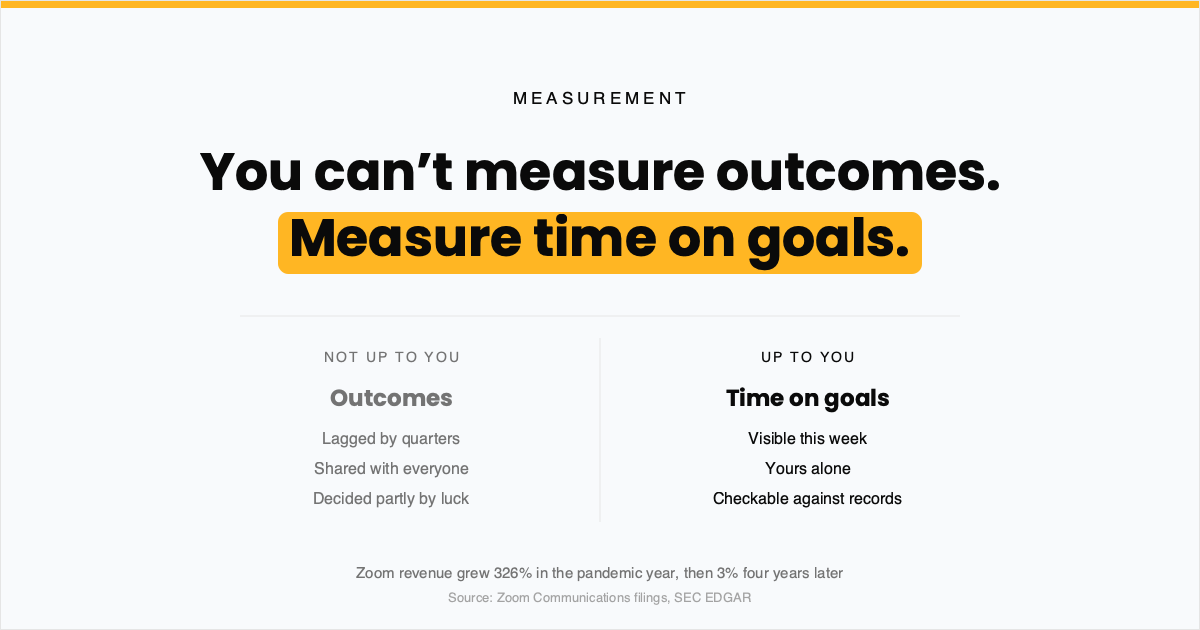
Everyone says measure outcomes. For individual knowledge work that mostly doesn't work — outcomes lag, they can't be attributed, and luck dominates. Here is the measurable alternative: time on goals, paired with energy.