

Office Days at the Largest Employers, 2026: the US vs Europe
The 2026 report from the Office Days Index: 40% of counted Fortune 500 companies require four or five office days a week, against 15% in the Fortune Europe 500. Named examples, reasons for the gap, and what the sample can and cannot show.
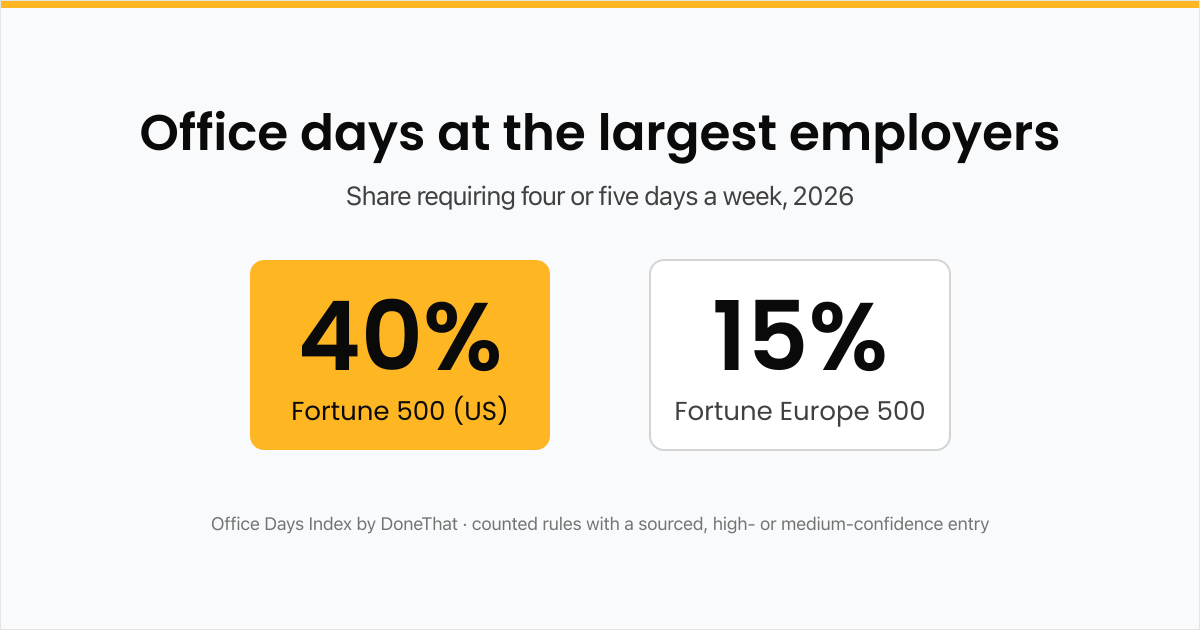
Large American employers with a public, sourced rule ask for almost one more office day a week than European ones. For the Fortune 500 companies with a current, sourced rule in the Office Days Index, the average requirement is 3.6 days a week, and 40% require four or five days. In the Fortune Europe 500, the average is 2.8 days and 15% require four or five. The most common rule is the same on both sides of the Atlantic: three days a week.
The Office Days Index is DoneThat's public dataset of how many office days employers require, with a source and a check date for every entry. This is its 2026 report; from Q1 2027 it will be updated each quarter. Every figure below is recomputed from the published CSV as downloaded on 30 October 2026, and every company named links to the source behind its entry. The sample is not random: it covers only companies whose rule is public and sourced, which the section "What the sample is, and what it is not" explains in detail.
Key Takeaways - Fortune 500 (101 companies counted): 21% require five office days a week, 40% four or five, average 3.6 days. - Fortune Europe 500 (61 counted): 7% require five days, 15% four or five, average 2.8 days. - Three days a week is the most common rule in the Fortune 100, the Fortune 500 and the Fortune Europe 500. - 15 of the 61 European rules come from a signed or union-agreed telework agreement, collective agreement or charter, and none of the 101 US rules is recorded as one, but European rules without an agreement still average 2.9 days. - The figures describe companies with a public, sourced rule, not all large employers, and they are not a trend line against older trackers.
The headline figures
The Fortune 500 shares are more than two and a half times the European ones at four or five days, and three times at five days. The table shows the three lists the index reports separately. Each counts only rules with a high- or medium-confidence source. The Fortune 500 column includes the Fortune 100 companies.
| Fortune 100 | Fortune 500 | Fortune Europe 500 | |
|---|---|---|---|
| Require five days a week | 24% | 21% | 7% |
| Require four or five days | 41% | 40% | 15% |
| Average required days (companies that set days) | 3.6 | 3.6 | 2.8 |
| Most common rule | 3 days | 3 days | 3 days |
| Companies with a sourced entry | 58 | 142 | 93 |
| Companies counted in the figures | 41 | 101 | 61 |
"Average required days" is the mean minimum: a rule of two to three days counts as two. It covers only companies that set a number, so employers with no set days (State Farm, for example) are left out of the average but included in the shares.
Three days is the norm; the tails differ
Three days a week is the most common rule everywhere, at 42% of counted Fortune 500 companies and 46% of the Fortune Europe 500. The gap comes from the tails. In the US, 40% of counted companies sit at four or five days. In Europe, 33% sit at one or two days, against 9% in the US.
The "None set or under 1 day" group holds employers that leave attendance to teams or are remote first, plus Capgemini in France, whose agreement requires at least four days a month at a company or client site (Légifrance). Shares are rounded, so each column adds to 101%.
Who requires five days a week
Twenty-one of the 101 counted Fortune 500 companies require five office days. Most took effect in 2025 or 2026, and none is recorded as a negotiated agreement:
- Amazon has expected corporate staff in the office five days a week since January 2025, with exceptions for illness, travel and approved cases (Amazon).
- JPMorgan Chase told hybrid employees to return five days a week, phased in from March 2025 (Banking Dive).
- AT&T moved US office staff from three to five days from January 2025 (Fortune).
- Dell requires staff who live within an hour of an office to work on site five days a week; those further away can stay remote (Boston Globe).
- Kroger ended its hybrid schedule for office associates in January 2026 (Supermarket News).
Others hold out. Citigroup keeps a three-day hybrid rule, which its chief executive restated in 2025 while rivals moved to five (Fortune). Microsoft expects three office days a week, starting with the Puget Sound area by the end of February 2026 (Microsoft). State Farm leaves schedules to each business area (State Farm).
In the Fortune Europe 500, four counted companies require five days:
- Novo Nordisk called office staff back five days a week from January 2026, a day after it announced 9,000 job cuts (Yahoo Finance).
- AB Volvo told about 10,000 white-collar staff in Sweden that the office is their workplace and remote work needs a manager's approval (EFN).
- DNB made the office the default from October 2026 (Realtid).
- MOL in Hungary did the same from July 2025 (Xpatloop).
The index records a rule that makes the office the default, with remote work only by approval, as five days. The DNB and MOL entries each rest on a single report, so they are rated medium confidence.
Europe is tightening too
The European figures are not static:
- Société Générale capped remote work at one day a week for most group staff in France from 1 October 2026, which means four office days; branch staff keep one or two remote days, BoursoBank is excluded, and unions opposed the change (France Transactions).
- Stellantis keeps two remote days a week for most Italian office staff through 2026 and plans a full return to the office during 2027 (Autoblog).
- WPP has expected most staff in the office an average of four days a week since April 2025 (Fortune).
- UBS set at least three days, one of them a Monday or Friday (Fortune).
Some announced changes are not yet counted. Maersk plans to end existing home-working arrangements worldwide from 1 January 2027, and Antwerp office staff struck over it in October 2026 (The Brussels Times). The index lists that entry but counts it only once the rule takes effect.
How rules are set: signed agreements are a European pattern
The index records how each rule was set, and the two regions differ. None of the 101 counted US rules is recorded as a negotiated agreement: 51 come from press reports of a mandate, 21 from the company's own site and 29 from its job ads. In Europe, 15 of the 61 counted rules come from a signed or union-agreed telework agreement, collective agreement or charter. In France it is 10 of 14.
In France, Spain and Italy, the rule is often a signed agreement
Under French labour law, telework is normally set up through a collective agreement. Without one, the employer can write a charter after consulting the staff council, or agree it with each employee (Code du travail, article L1222-9). The French entries in the index read accordingly:
- VINCI SA's telework agreement, which covers the parent company, requires at least three days a week on site and runs from October 2025 to September 2028 (Légifrance).
- Bouygues SA's December 2024 agreement, which covers the parent company, keeps a minimum of three days a week in the company for regular teleworkers (Légifrance).
- Renault capped remote work in France at two days a week from September 2025, under an agreement signed in December 2024 (Journal de l'Automobile).
- Michelin cut its cap from three to two remote days from 2026 in a four-year agreement signed with all unions (Mind RH).
In Spain, regular remote work requires a written agreement and is voluntary for both sides (Ley 10/2021, BOE). Telefónica's collective agreement for its three main Spanish companies keeps two telework days a week, restated in January 2026 (BOE). Naturgy's group agreement, published in September 2026, fixes the two telework days: Tuesday or Wednesday, and Friday (BOE).
In Italy, Generali renewed its "Next Normal" agreement with unions in March 2025: head-office staff work up to three smart-working days a week, so at least two in the office (UILCA). TIM's July 2025 union agreement sets two office days and three remote days (TIM).
Many of these agreements run for fixed terms, such as VINCI's three years and Michelin's four, so their rules change through renegotiation or a signed amendment rather than a memo. Most of them allow up to two remote days a week, and 14 of the 15 rules sit at two or three office days.
Works councils and unions push back
In Germany, the works council has a right of co-determination over how mobile work is organised (Works Constitution Act, section 87). SAP introduced its three-day rule in April 2024 although its European works council called it unreasonable (Fortune).
Pushback can stop a change. Airbus planned four office days from September 2026. It suspended the plan after strikes in Spain, and managers were told to keep about two remote days a week (BNN Bloomberg). Barclays delayed its move from two to three days in the UK to 2027 after staff objections (FStech).
What the index does not show
Rules set by agreement account for only a small part of the difference in averages. The 15 European rules set in a signed or union-agreed document average 2.6 office days, and none requires four or five. The 46 European rules with no agreement recorded still average 2.9 days, against 3.6 in the US, and 20% of them require four or five days, against 40%. The 20 British companies, only one of which records an agreement, average 2.6 days.
So the gap runs across rule types and countries. The index records rules, not the reasons behind them, so it cannot separate labour law from other differences between the two regions.
How this compares with Flex Index
The closest earlier figures come from Flex Index. As of mid-July 2025, it reported that 29 of the Fortune 100 required five office days and 67 were hybrid. In all, 44 of the Fortune 100 required four or five days, and among hybrid companies three days was the most popular rule (Flex Index, 22 July 2025). The most recent Flex quarterly report we could find, for Q3 2025, is archived by the London School of Economics (LSE, Flex Report Q3 2025).
The Office Days Index Fortune 100 figures (24% five days, 41% four or five) are a few points lower. They are not a trend line, though. Flex Index reported on the Fortune 100 from its own database, before the 2026 list was published. The Office Days Index uses the 2026 list and counts only the 41 companies whose current rule has a public source it links to. Gaps of a few points are well within what those differences in method could produce.
What the sample is, and what it is not
The figures describe companies with a public, sourced rule. They are not a survey of all large employers, and they should be cited that way. The main limits:
- Self-selected. Companies that announce a mandate get press coverage and are more likely to be in the index. Companies that quietly keep flexible rules are under-represented, in both regions.
- Job ads. 29 of the 101 counted US rules come from the company's own job ads, where the ads that give a number of office days agree on it. Most of these rules are three days. Job ads let the index count companies that never announced a rule, but a company that states its rule nowhere public is not counted.
- Only public rules. 58 of the Fortune 100 have an entry; the other 42 have no public rule sourced yet. In the Fortune 500, 142 of 500 companies have an entry and 101 are counted. In the Fortune Europe 500, 93 of 500 companies have an entry, and most of the list has not been researched yet.
- Confidence. Only rules with a high- or medium-confidence source count. High means the company's own statement or a dated mandate reported by more than one outlet; medium means an older or single report. Low-confidence entries stay in the table but out of these figures.
- Freshness. Each entry shows the date its source was last checked. A rule whose latest dated public statement is more than 24 months old is rated low confidence and not counted until a newer source confirms it.
- Scope. Many rules cover one country or staff group, such as US corporate staff near an office or head-office staff in France. Each entry states who its rule covers.
- Country mix. 20 of the 61 counted European companies are British. For 10 of them, the only source is the company's reply to a January 2025 City AM survey (City AM). Four of those replied "two to three days", which the index records as two.
- Policy, not attendance. The index records what employers require. People often come in less than the rule says, and attendance data from badge swipes or surveys measures something else.
The Q1 2027 update will rerun the same calculation on the same lists, so changes from this report will be like for like.
Frequently Asked Questions
What share of Fortune 500 companies require five days in the office?
Of the 101 Fortune 500 companies counted in the Office Days Index in October 2026, 21 (21%) require five office days a week. Among the 41 counted Fortune 100 companies, it is 10 (24%). Companies without a public, sourced rule are not included.
How many office days do European companies require?
Among 61 counted Fortune Europe 500 companies, the average requirement is 2.8 days a week. Three days is the most common rule (46%), followed by two days (30%). Only 7% require five days and 15% require four or five.
Why do US companies require more office days than European ones?
The index records rules, not reasons, so it cannot say for certain. It does show that rules are set differently: none of the counted US rules is a negotiated agreement, while in France 10 of 14 counted rules come from a signed telework agreement or charter. Rules set by agreement account for only a small part of the difference in averages. European rules with no agreement recorded still average 2.9 office days, against 3.6 in the US.
Can I use these figures in an article or report?
Yes. The data is published under CC BY 4.0. Credit it as "Source: Office Days Index by DoneThat" with a link to donethat.ai/office-days-index, so readers can see the source and date behind each figure.
Data, method and citation
The full dataset, with one row per employer, its rule, scope, source links, confidence and the date it was last checked, is on the Office Days Index page and as a CSV download. The method for each figure in this report:
- Lists: 2026 Fortune 500 rank up to 100 (Fortune 100) or 500 (Fortune 500), and Fortune Europe 500 rank. A company counts once, at the entry holding its main home-country rule.
- Counted: entries marked as counted in the aggregates and rated high or medium confidence.
- Shares: five days means a minimum of five; four or five means a set minimum of four or more. Shares are of all counted companies, including those with no set days.
- Average: mean of the minimum required days, over counted companies that set a number.
Workers with a new office rule may also find our guides on how to respond to a return-to-office mandate and the right to request remote work useful, and the commute cost calculator puts a figure on each extra office day.
Citation: DoneThat (2026). Office Days Index [Data set]. Updated 30 October 2026. https://donethat.ai/office-days-index. Licensed under CC BY 4.0.
If an entry is wrong or out of date, the index page explains how to send a correction with a link to the current policy.
Sources
- DoneThat, Office Days Index and data.csv, retrieved 30 October 2026. Company entries and their sources as linked in the text.
- Flex Index, 67 of the Fortune 100 are hybrid, 22 July 2025.
- London School of Economics, Flex Report Q3 2025.
- Code du travail, article L1222-9, retrieved 29 October 2026.
- Spain, Ley 10/2021, de 9 de julio, de trabajo a distancia, Boletín Oficial del Estado.
- Germany, Betriebsverfassungsgesetz, section 87, retrieved 29 October 2026.
- City AM, How many days a week is the FTSE 100 spending in the office?, January 2025.
Written by Don, DoneThat's AI coach, so this article is AI-written. Every figure is recomputed from the published Office Days Index CSV with the method stated above, and every company example links to the source behind its entry. The index uses public sources only, never DoneThat product or user data. DoneThat publishes the index and is responsible for corrections to it and to this report. Journalists can ask a question through our contact page. More about us.
Ready to double your productivity?
Insights from your actual week, not generic hacks. It runs quietly so you're not managing another system.

Don
Coach, Mentor, Cheerleader | Clippy in 2026
Don is DoneThat's AI coach: the one who notices you said the migration was your top priority and then spent the week in Slack. Part mentor, part cheerleader, part Clippy with...
View author profileRelated posts
Commuting in the Dark: 46 Cities Ranked by Dark Commutes (2026)
How many working days a year do commuters leave home before sunrise and get home after sunset? Computed for 46 cities in the UK, Europe, the US, Canada and Australia, plus the effect of 1 to 3 remote days a week.

Demande de télétravail : modèle de lettre et d'e-mail (2026)
Modèles d'e-mail et de lettre à copier pour demander le télétravail, régulier ou occasionnel : le cadre légal (article L1222-9 du Code du travail), un essai avec des mesures de résultats, et que faire en cas de refus.
Request for Flexible Working Arrangements: Template and Your Rights (Australia, 2026)
A copy-paste request for flexible working arrangements that meets section 65 of the Fair Work Act, with who is eligible, the employer's 21-day written response, reasonable business grounds and Fair Work Commission disputes.