
You should probably track your time (and it just got easier)
Most people in EA know they should track their time but don't, because existing tools are either too much work or not accurate enough. Here's why it's worth doing and a new AI-powered option that fixes both.
This post was originally published on the EA Forum on October 14, 2025.
TLDR
EA is a community where time tracking is already very common and yet most people I talk to don't because:
- It's too much work (when using toggl, clockify, ...)
- It's not accurate enough (when using RescueTime, rize, ...)
I built donethat.ai that solves both of these with AI as part of AIM's Founding to Give program. Give it a try (and use discount code "EA" after the 14d trial to get another month free).
You should probably track your time
I'd argue that for most people, your time is your most valuable resource. Even though your day has 24 hours, eight of those are already used up for sleep, another eight probably for social life, gym, food prep and eating, life admin, commute, leaving max eight hours to have impact.
Oliver Burkeman argues in his recent book Meditations for Mortals that eight is still too high - most high impact work gets done in four hours every day - the rest is just fluff and feeling busy.
Now, how do you spend those four hours? When it comes to our other scarce resource - money - most people and companies keep budgets, there is a whole discipline of accounting to make sure it's spent wisely. But somehow, for time, we just eyeball it.
When tracking time, the objective isn't to set a number and play "number go up." The objective is to understand where you spend your time and help you prioritize and plan better. AI is estimated to increase workforce productivity by 5%. Imagine the increase of productivity if everybody would be better at planning and prioritization.
One last reason that is often overlooked: Tracking time can reduce anxiety and guilt. We often feel like we should "do more" but there is always more to do. By setting realistic time-based goals like "work 4h/d on project X" we have a clear measure when we achieved the goal and have also full control over the outcome.
If you want to dive deeper than just these handwavy arguments into why it's useful, check out the LW post by Lynette, or the discussion in this post on how much time people work.
It just got easier
I talked to a lot of EAs this year at various EAGs and EAGxs and the most common reason for why they are not time tracking is "I tried it but couldn't build the habit". When poking a bit more that was usually because it's too much work to manually track and when doing it automatically the data quality wasn't high enough to keep doing it.
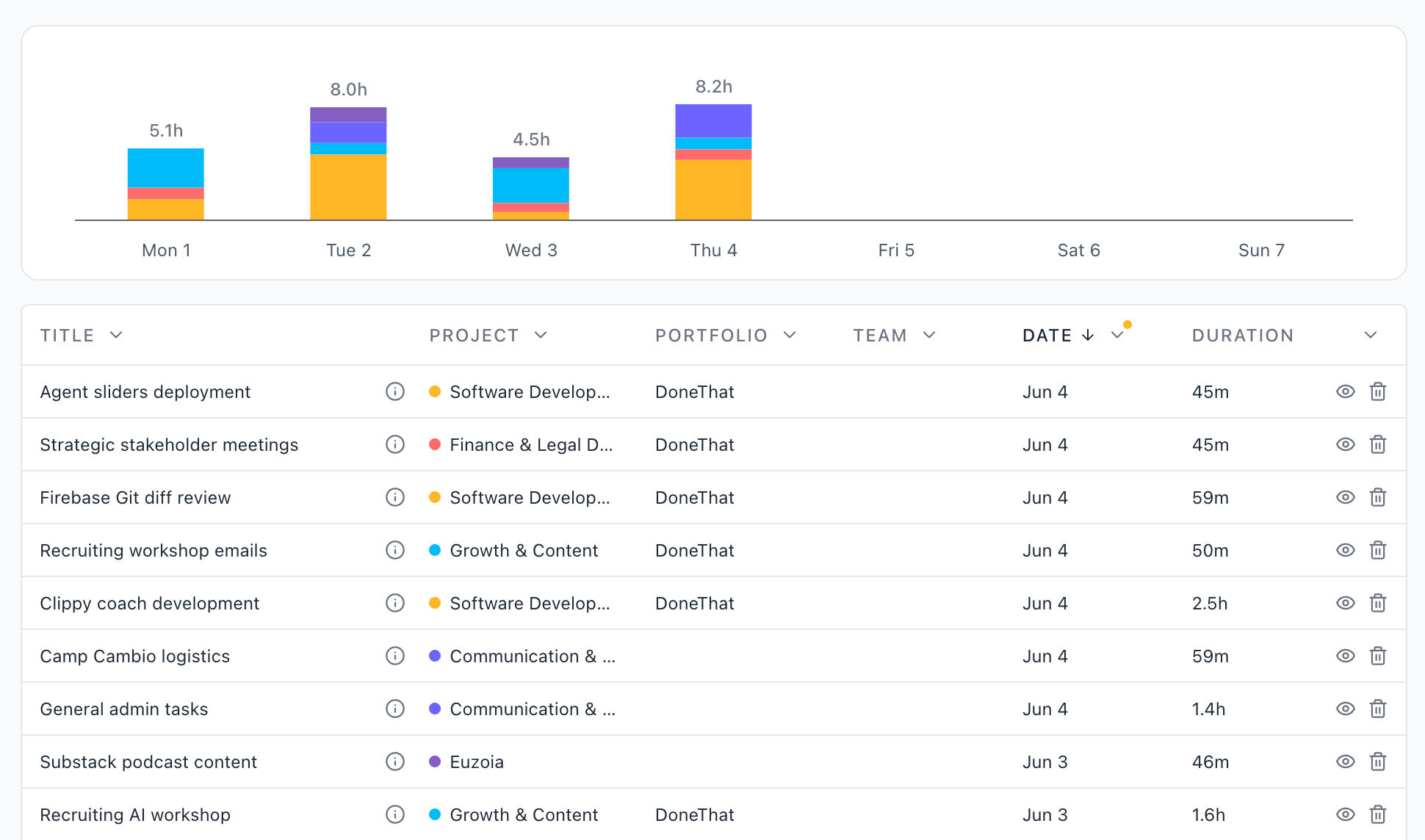
Earlier this year I joined AIM's Founding to Give program and built donethat.ai - a time tracker that uses AI to fully automate data capture and analysis. It literally takes two minutes to set up and you can forget about it afterwards.
It's not perfect yet, it never will be, but it already helped a bunch of EAs be more productive (and they helped me to improve the tool, thank you!!!). If you feel something is missing, always let me know, and feel free to check out my list of similar tools - maybe you'll find something that works better for you.
If you want to give it a try, please check it out. It's free for 14 days and you can use discount code "EA" to get an extra month for free after that. If you're thinking about using this as a team, please reach out, I'd love to work more with teams as I think that's where the biggest impact is but it's also more sensitive than when just tracking individually.
Ready to double your productivity?
Insights from your actual week, not generic hacks. It runs quietly so you're not managing another system.
Christoph Hartmann
Christoph is the founder of the AI productivity startup https://donethat.ai . He has over fifteen years experience in AI, including a PhD, a stint at BCG, and as a CTO for a...
View author profileRelated posts
Trace the Work. Calendars Are Not a Log.
Rahul Vohra found 6-7% of his week on craft work a calendar would never have shown. A calendar is intention. A switch log is the trail. Microsoft telemetry explains the gap, and memory is not a backup.
Why You Cannot Categorize Time From Memory
Reconstructing how you spent a week from memory or a calendar fails. Sam Corcos logged 17,784 hours and still would have put recruiting at 20% instead of 3%. Contemporaneous logs plus a small category set is the practice.
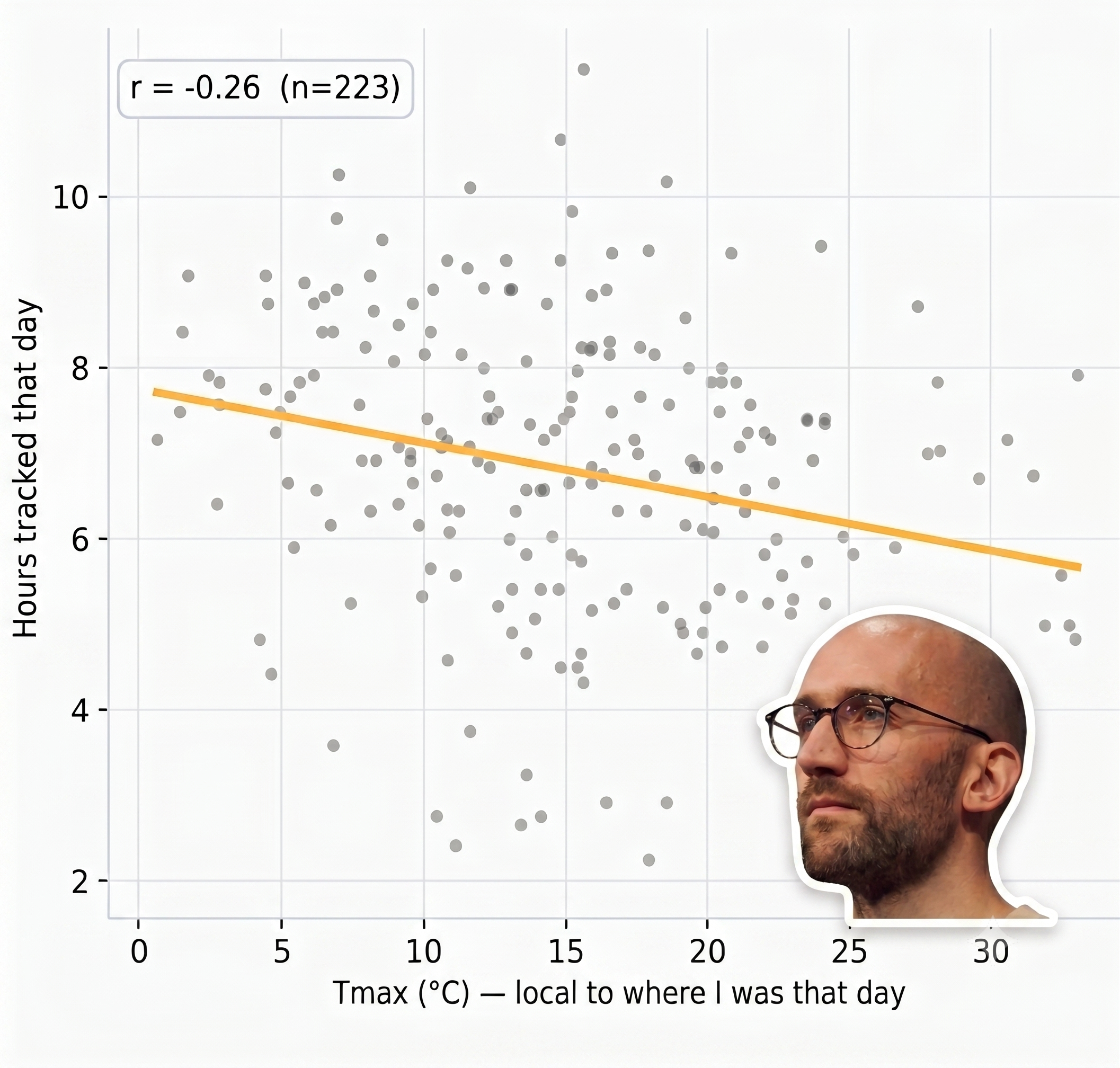
Dogfooding DoneThat: AI Watched My Screen for A Year
What happens when an AI tracks your screen every 5 minutes for a year? Data-driven productivity insights from 1,585 hours of solofounder work.