
Dogfooding DoneThat: AI Watched My Screen for A Year
What happens when an AI tracks your screen every 5 minutes for a year? Data-driven productivity insights from 1,585 hours of solofounder work.
For one year, DoneThat took a screenshot of my screen every five minutes. An LLM turned each capture into a short description, a category, and a project. One year into dogfooding my own product, I decided it was time to point Claude at the data and see what happens.
Curious to try DoneThat? Check it out here and read more about our data privacy safeguards here.
How it felt
What happens when you know an AI is keeping track of what you’re doing? This is highly personal, and it will feel different for everybody, I can share what it felt like for me:
On a high level, I forgot about it very fast. This is maybe similar to the experience of driving a Waymo: The first few minutes you can’t stop talking about it and then it’s just another ride.
On a more subtle level, I noticed that I felt more on track and a bit more guilty when procrastinating. This is partly because I made my DoneThat profile public but I tend to forget that, I think it’s more like the Hawthorne effect that you change behavior when you know you are being watched, and at least for me that works also with AI.
This got stronger when I added a feature so Don, DoneThat’s mascot, would proactively reach out and ask me to set goals, get back on track, cheer me on. While the “get back on track” was often misguided I did notice that the cheer felt surprisingly good. Something about getting small rewards for my efforts, being seen, even by a silly AI haha.
What I for sure didn’t feel was a need to work more hours. Mostly for two reasons: 1. I get exhausted and there is no point in pushing further (see analysis later) 2. As the founder of D, the last thing I want to do is model the the wrong behavior: I want people to use DoneThat to spend their time better, not spend more time.
What the data looks like
Ok, into the hard numbers:
The export has 31,698 classified activity intervals from June 9, 2025 to June 8, 2026. The analysis below uses 1,585 tracked hours across 244 active days. I joined it with Apple Health for sleep and workouts, plus local weather for wherever I was that day.
A day
Here is a single day, June 4, 2026. It had 100 captures and 8.2 h of tracked time.

Each block is about five minutes. Black is focus work. Orange is messaging or meetings. Grey is admin or other. You can already see a typical pattern: Checking emails in the morning, break for lunch, afternoon dip, focus block at the end, and some odd thing in the evening.
The full year
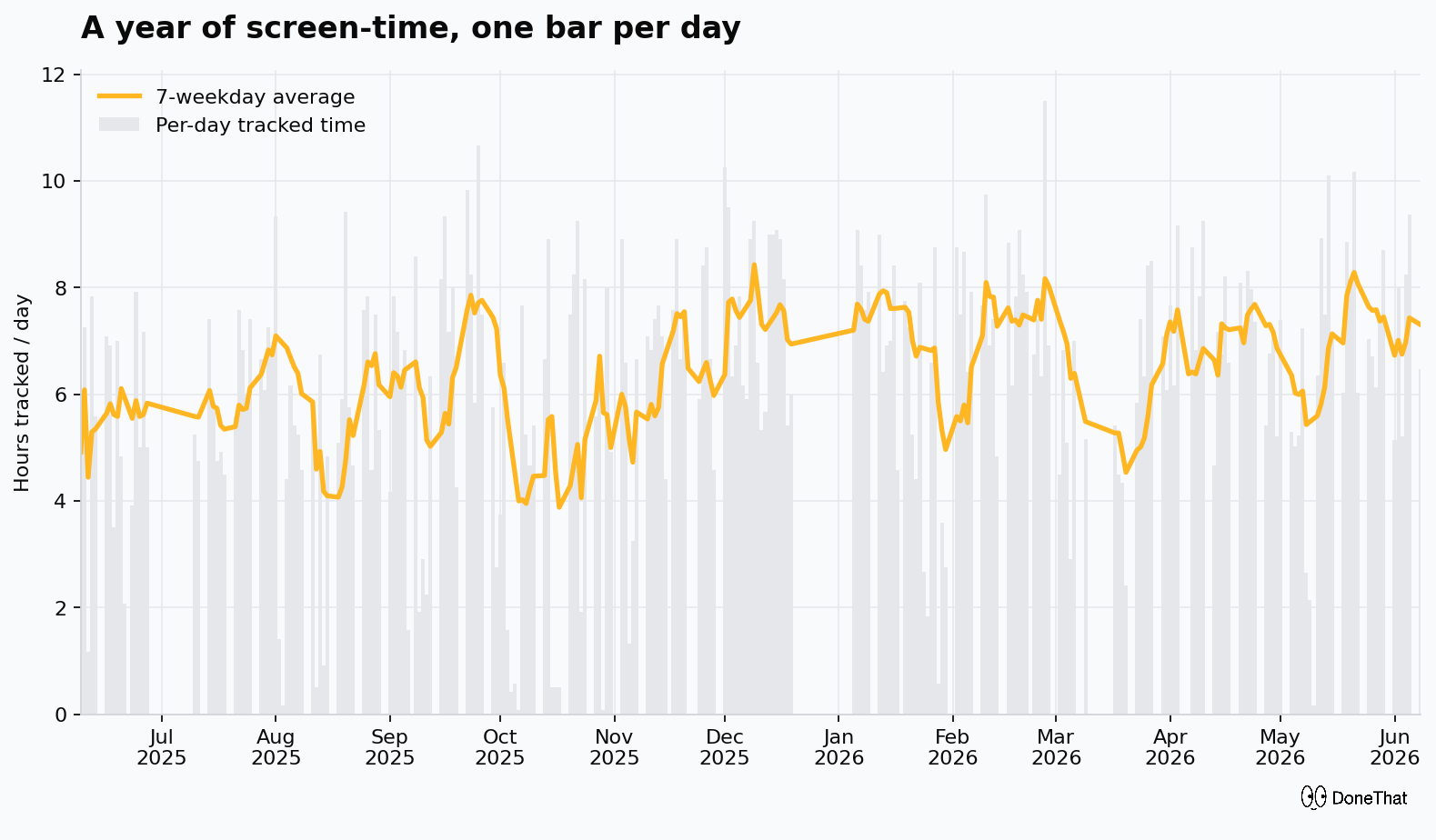
The headline: 1,585 h tracked, 6.8 h median active day, and the top 10% of days above 8.9 h. I always suspected I never work 8h, this is the proof.
I worked some weekends, but not many: 14 weekend days had more than 30 minutes tracked. The median weekend was 0.0 h. I have to admit sometimes I did work weekends and didn’t track it, but that was mostly on side projects.
Total time worked
4 hours of building per day
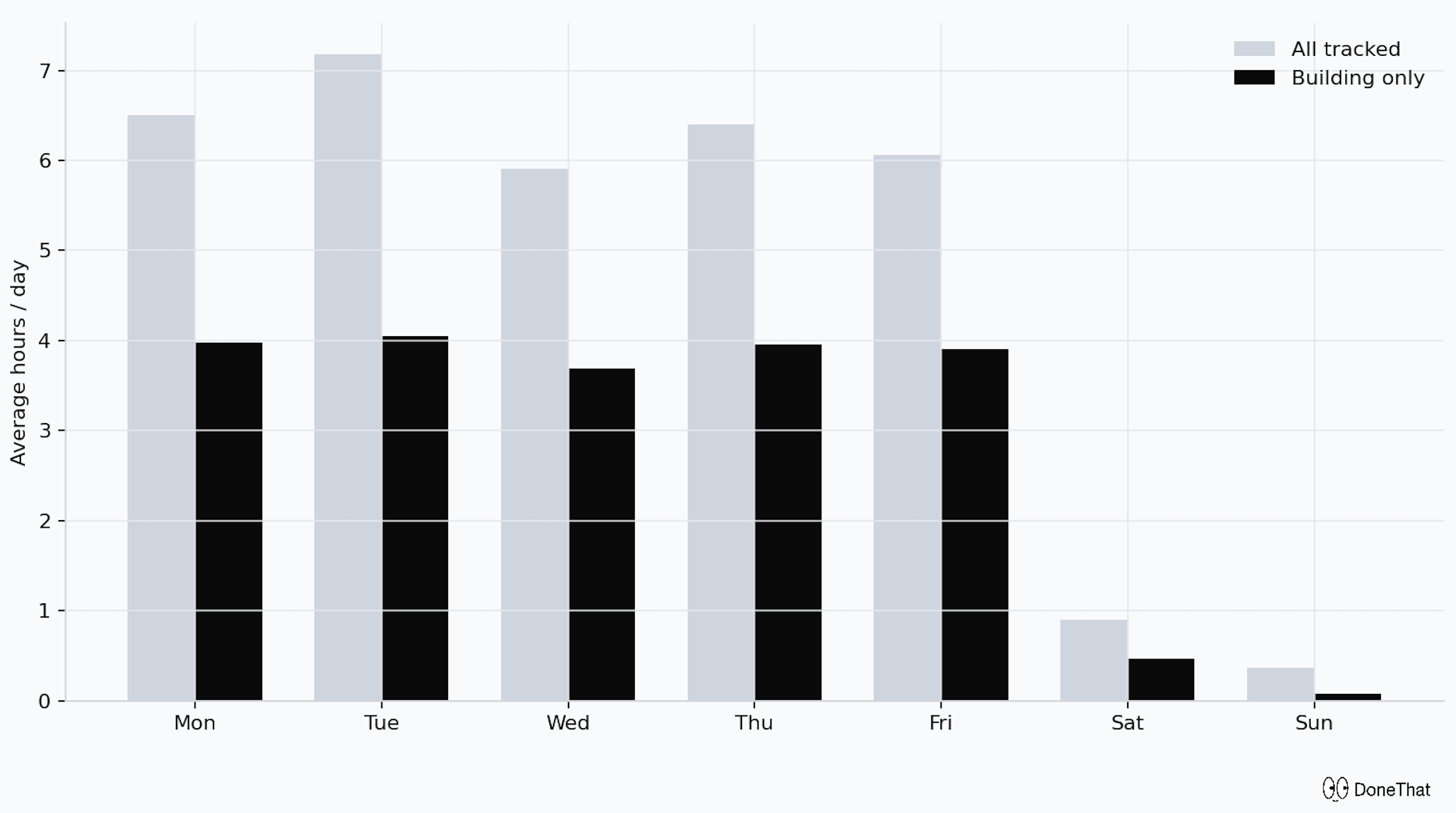
You probably heard about the “four hour rule”: Most people can’t do more focused productive work in a day. It’s for example mentioned in the great book Meditations for Mortals by Oliver Burkeman. I was really surprised how clearly this showed in the data without at any time trying to optimize for this.
The day feels longer than it is
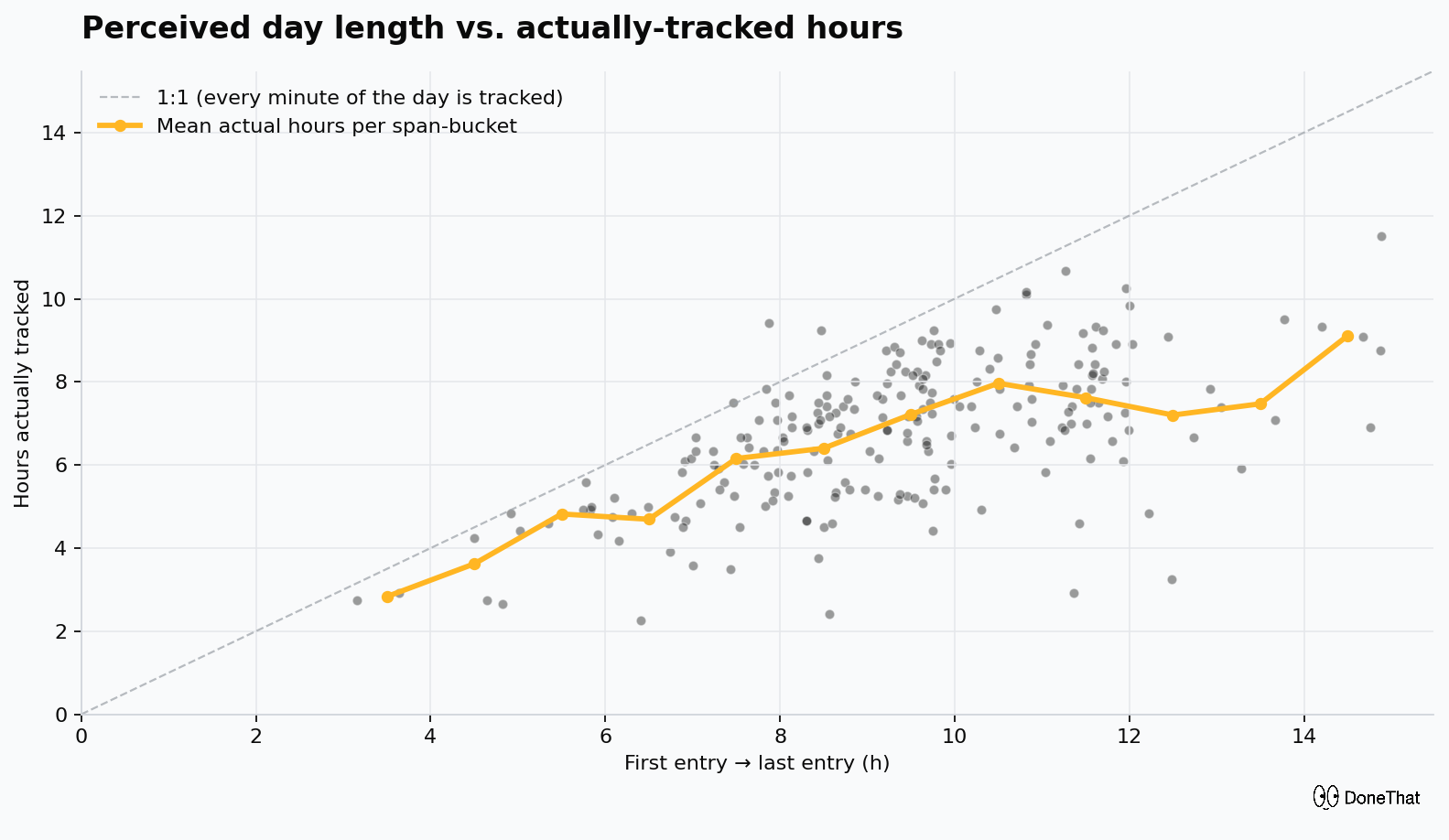
On workdays, the median span from first capture to last capture was 9.4 h. The median actually tracked time was 6.9 h. Median coverage: 75%.
So a "nine-hour workday" was often seven real hours plus two hours of gaps, food, errands, waiting, checking the fridge, checking the fridge again ten minutes later.
I would love to run this experiment for working in the office vs remote: My experience is this gets even worse if working in an office. I have a friend who used to work for Oracle and tracked the actual time he spent working. On good days he got four hours. He got promoted a few times.
There is no free lunch
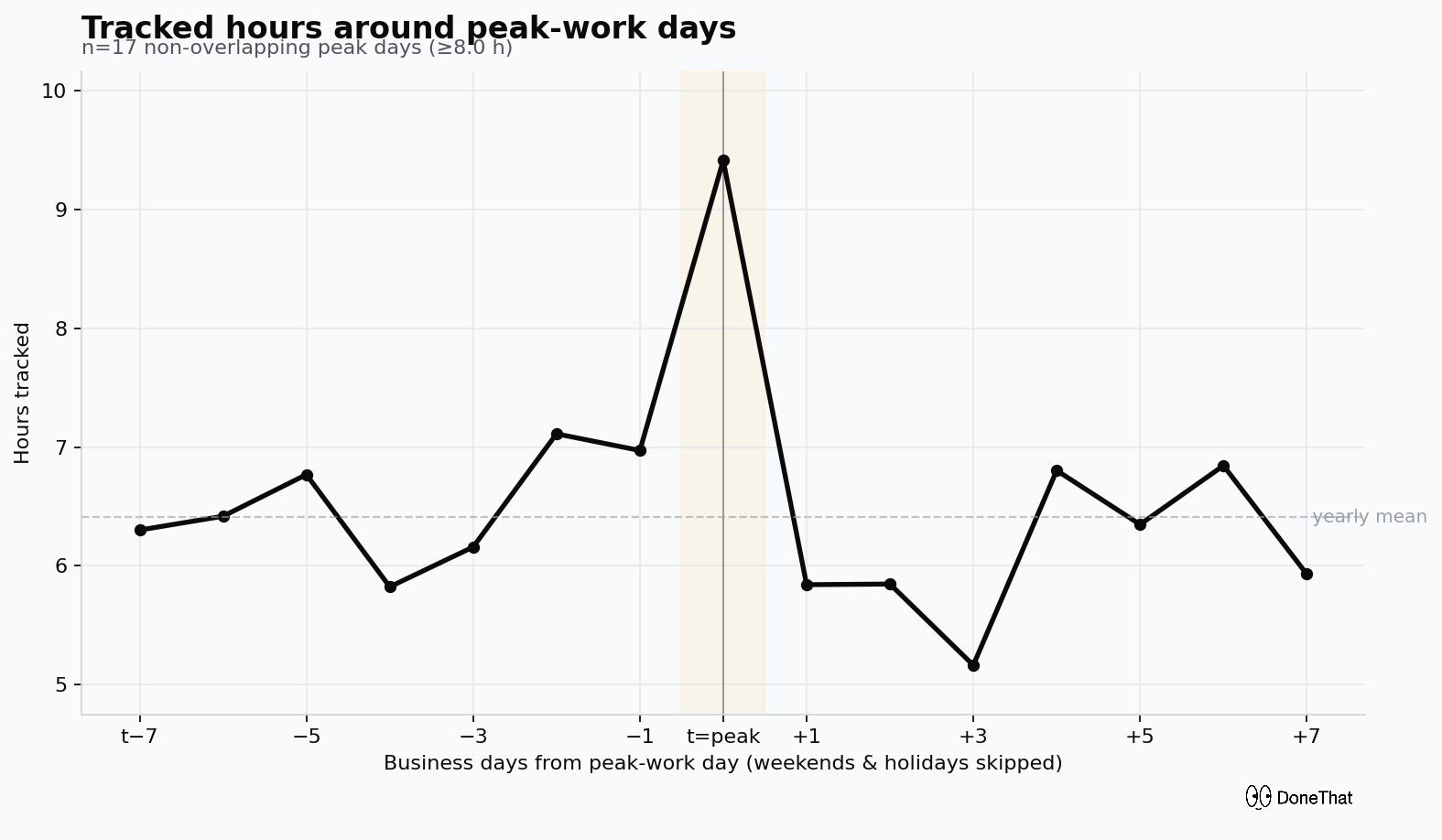
This one brought me back to my PhD days: Cross-correlation analysis! We’re looking here at the window before/after peak-effort workdays and if that had an effect. You can see that before we have a bit of a ramp up and after a recovery phase. Probably because I was pushing towards a deadline (before) and had to recover from it after. No free lunch for me!
Structure helps
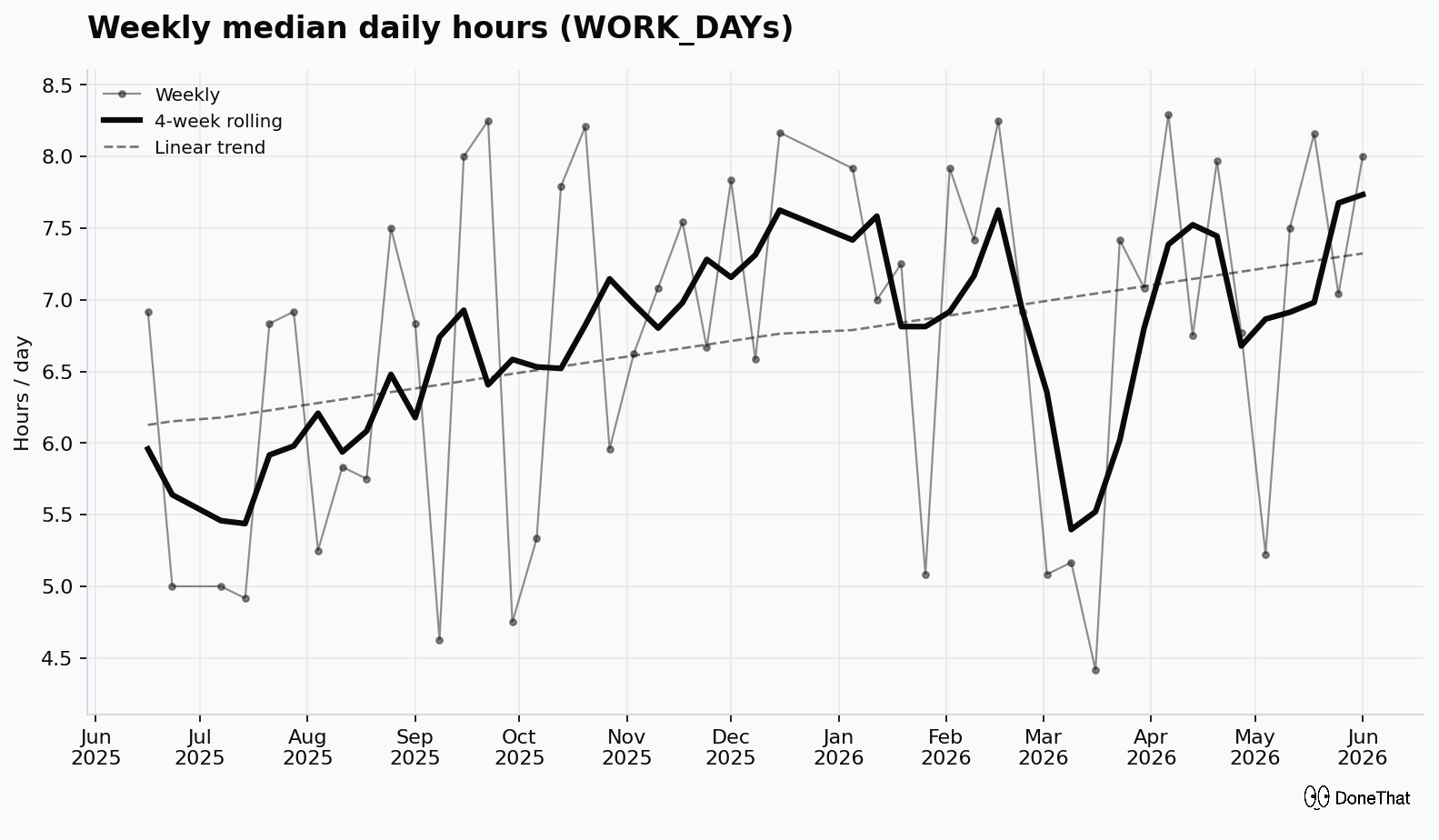
This one felt good. During the last 12 months, I slowly went from a pretty chaotic life to a pretty structured workweek. From traveling a lot, going to conferences, working remotely, to just being home most of the time and churning out work (minus a holiday dip in March). Great to see this validated in the data.
Focus work and project work
Lunch has a cost
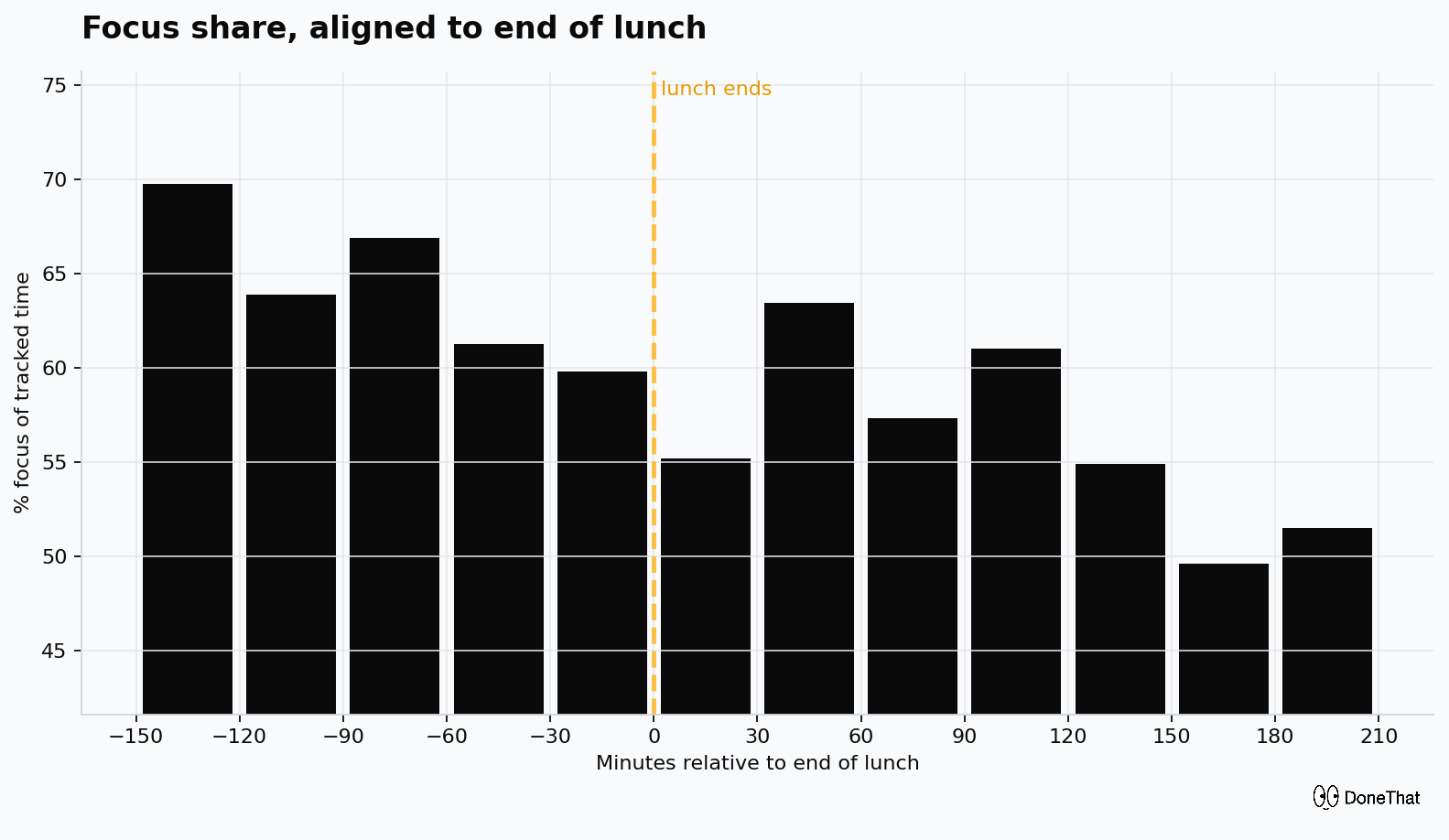
For 186 days with a detectable lunch break, the median lunch started around 12:52 and lasted 53 minutes.
The hour before lunch was 64.4% focus. The hour after lunch was 58.3% focus. Task switching also ticked up after lunch.
Another trend you see in this graph: For me, focus time just keeps going down the longer the day gets. My brain has limited capacity for focused work.
I am bad at multitasking
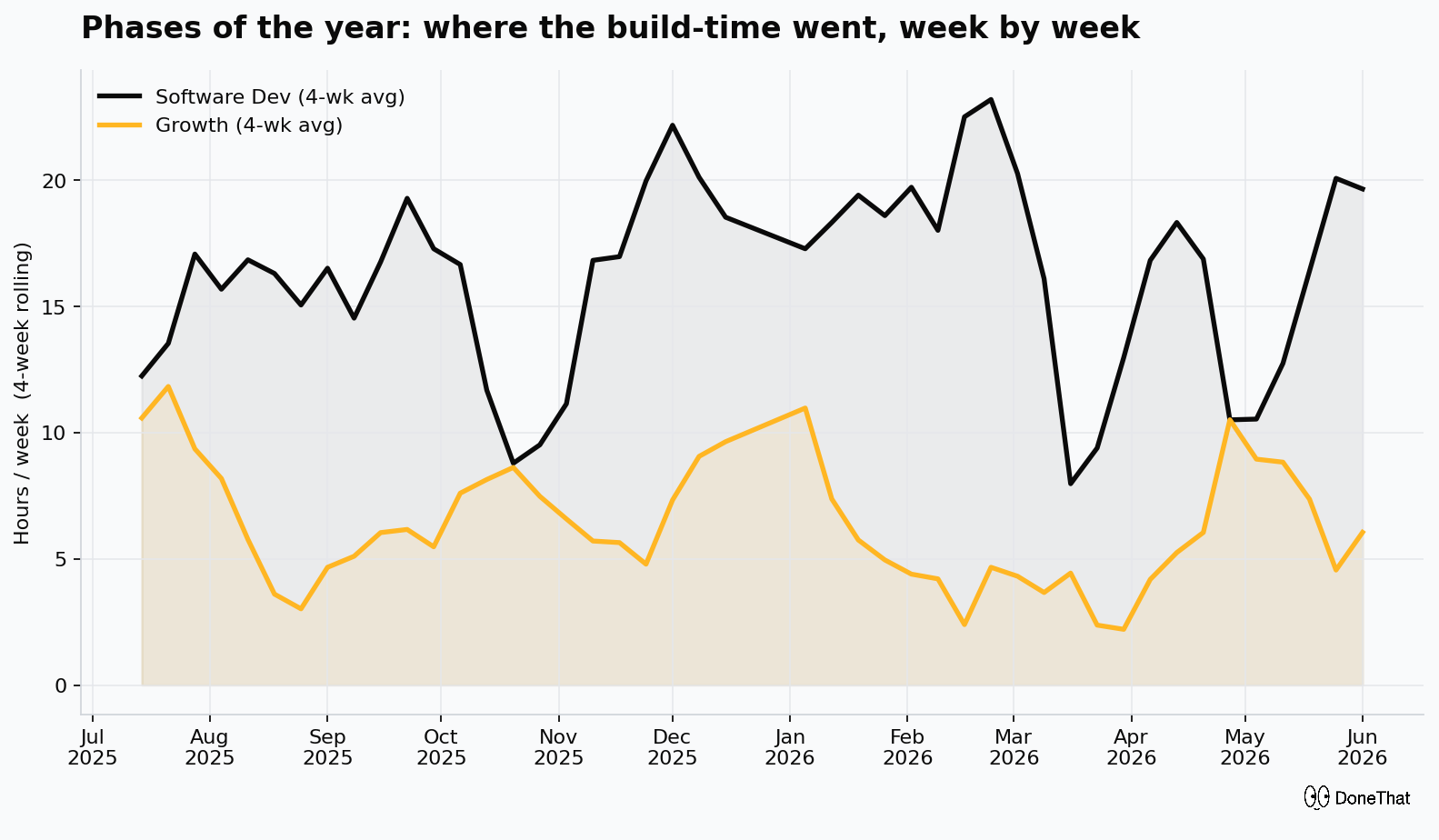
As a solofounder, what I do is the only thing that gets done. Focus on software development: No growth. Focus on growth: Product doesn’t get better. Initially I had this plan of “spend one day here one day there” but it never worked.
What did work: Push on growth until I get enough users with enough feedback that I realize I have to focus on product more. Once all is done focus on growth again, get more feedback, and around it goes.
The side-project cap actually held
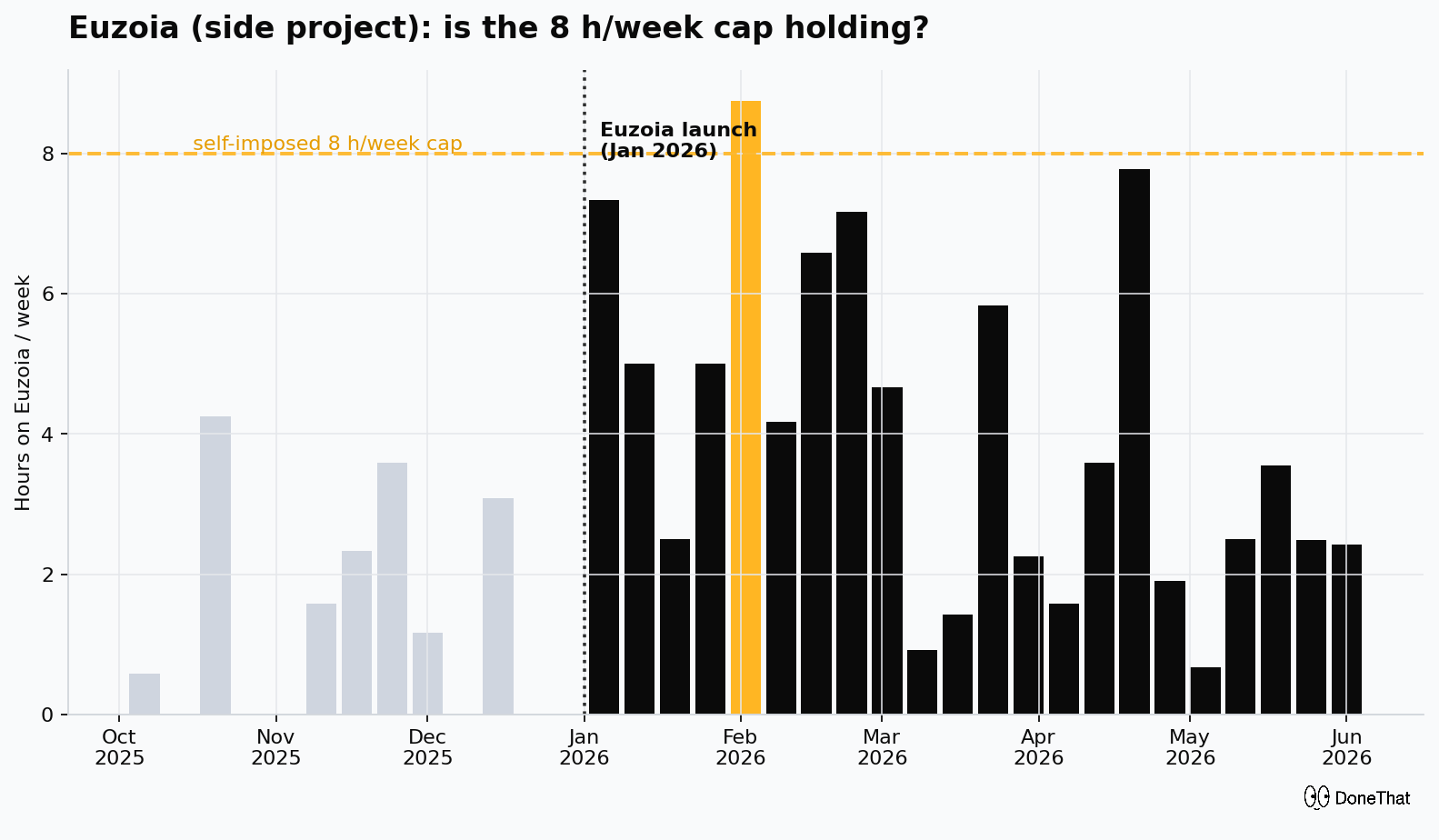
We’ve all been there. Starting a side-project and telling ourselves: “I’m only going to spend max one day per week on this”. This usually only ends in two ways: You give up or it eats way more than you thought it would.
I think tracking my time actually helped me in keeping this promise to myself and be really focused with my time. For Euzoia, a lifemaxxing blog, podcast, and app, we manage to now push out a blogpost, a podcast, and some app features every week while rarely going over the limit.
I have to admit though, I might have spent a few weekends on this untracked.
Still, the important part held: the side project stayed at 6.6% of total tracked time during the week and did not quietly eat the company.
Predicting productivity
The strongest signal? Getting up early.
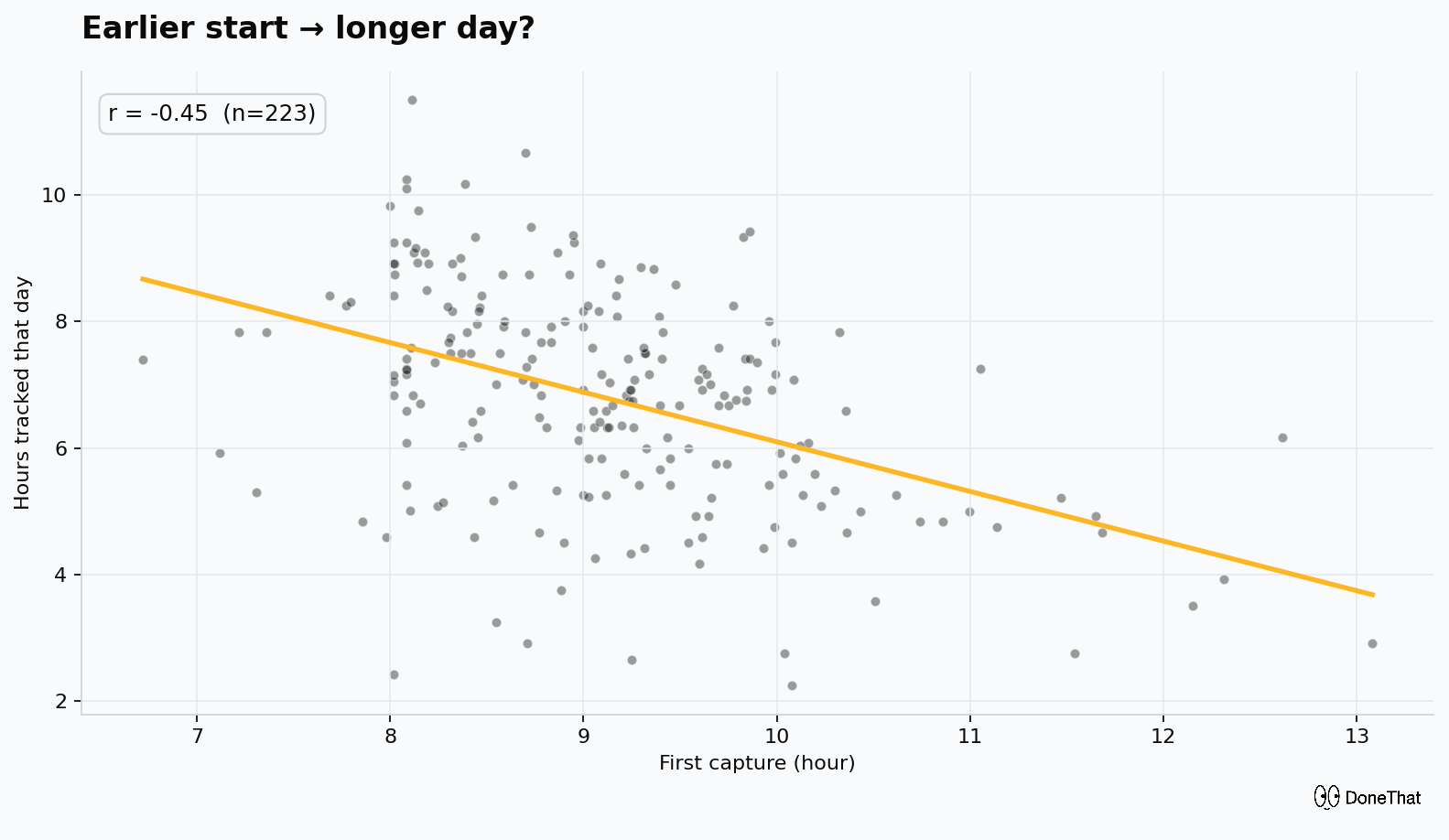
This one reveals my personality: I just sleep until I wake up and slowly get to work then. On most days it’s between 8 and 9 but facing that data that seems less hard than I thought haha.
My most productive hours are in the morning so when I miss those, I rarely get them back in the evening. Good to remind myself of this.
Sleep was less predictive than I wanted
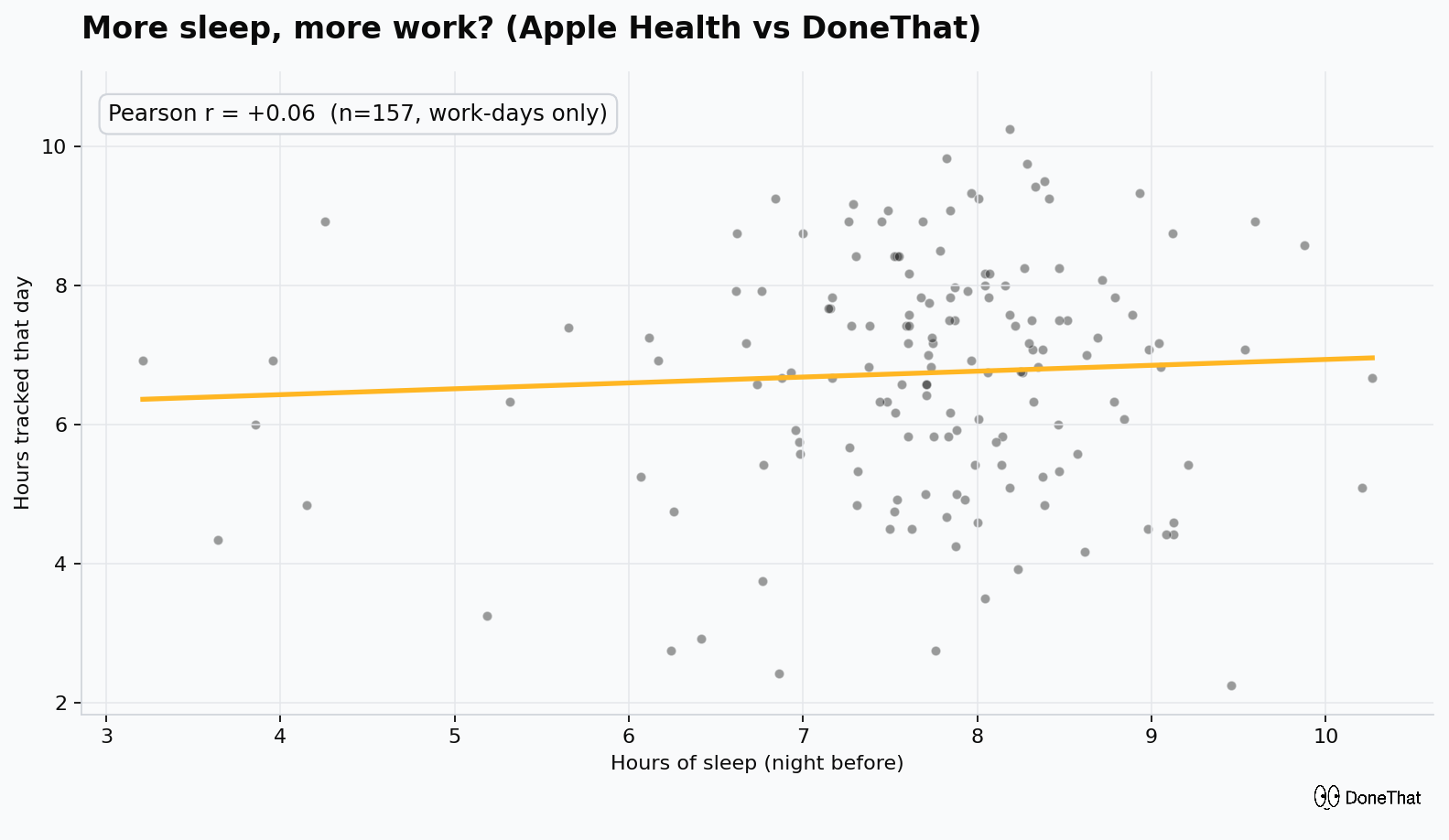
I was really surprised by this one: Hours of sleep the night before didn’t really predict how much I’d get done the next day. This could be because the sleep data is pretty noisy (sometimes my watch wouldn’t track full nights), or that my sleep is pretty regular in general.
Weather mattered more than sleep
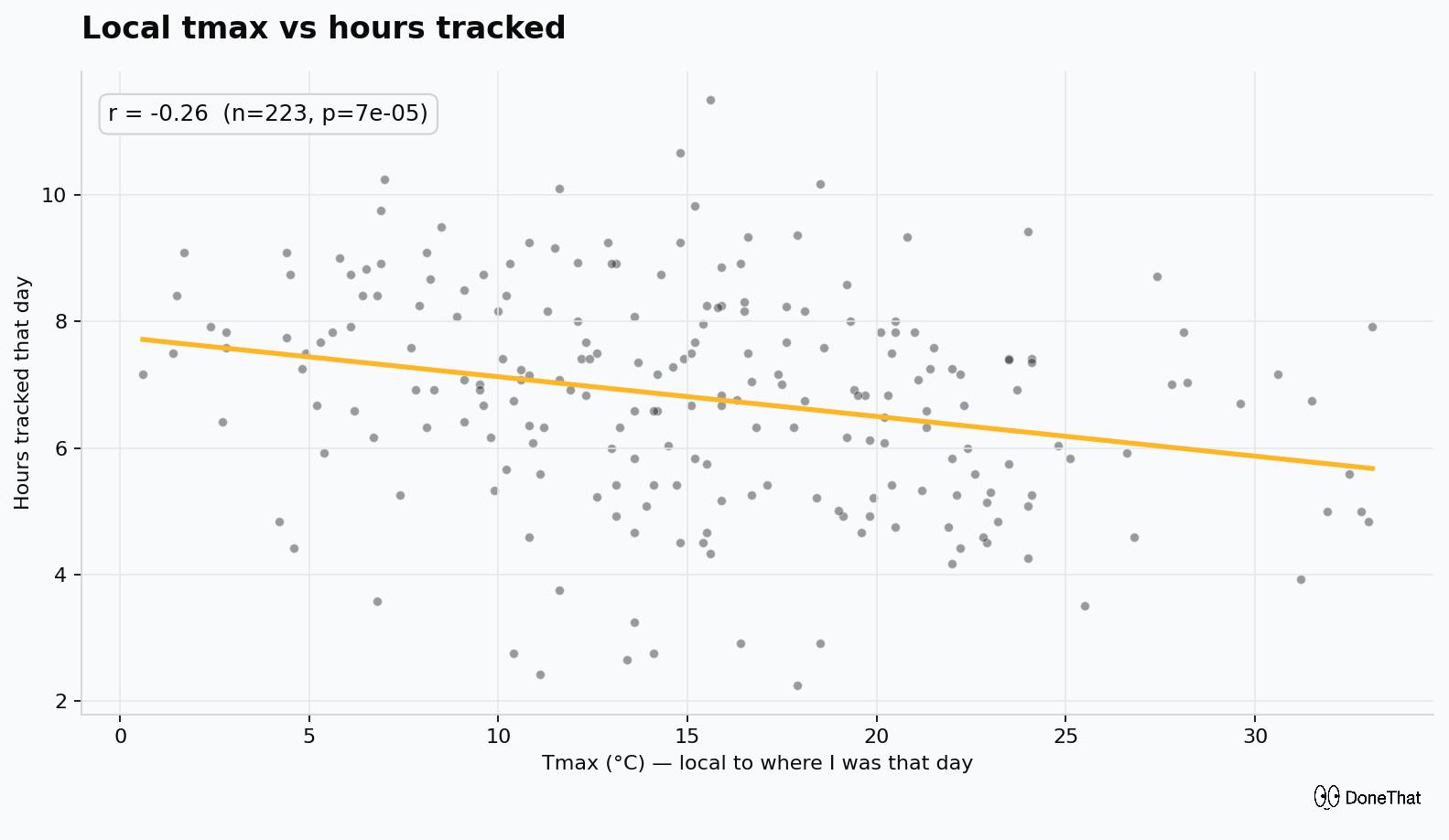
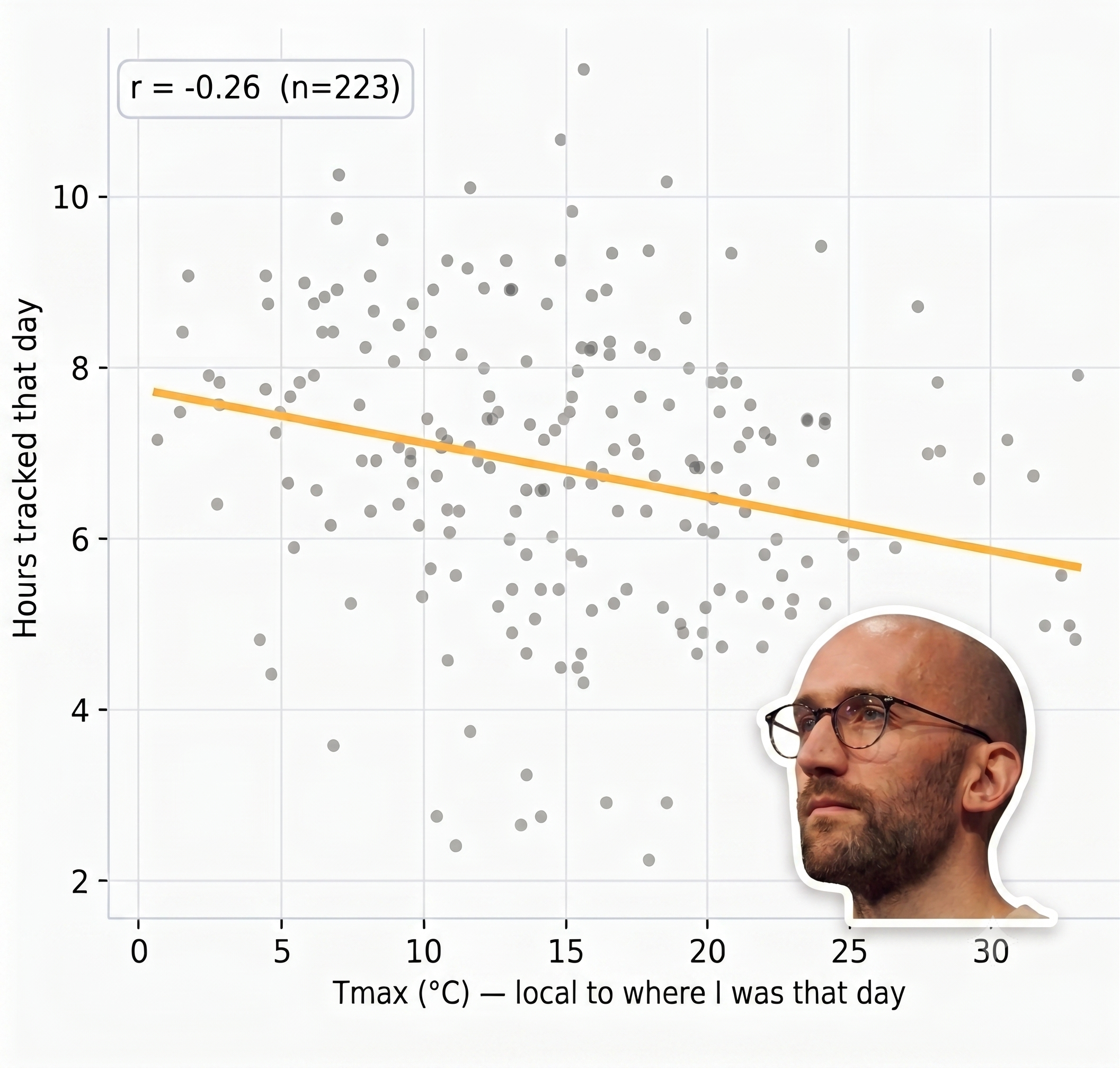
Local max temperature versus work hours had r = -0.26, p = 0.00007, n = 223. Heavy-tracking days had a mean high of 12.5 C. Light-tracking days had 18.1 C.
This is partly seasonality, partly Amsterdam doing free productivity coaching from November to February. Cold months are good for building. Warm months are good for remembering that the body exists. I’ll take this as a reason to do less winter holidays and more summer holidays.
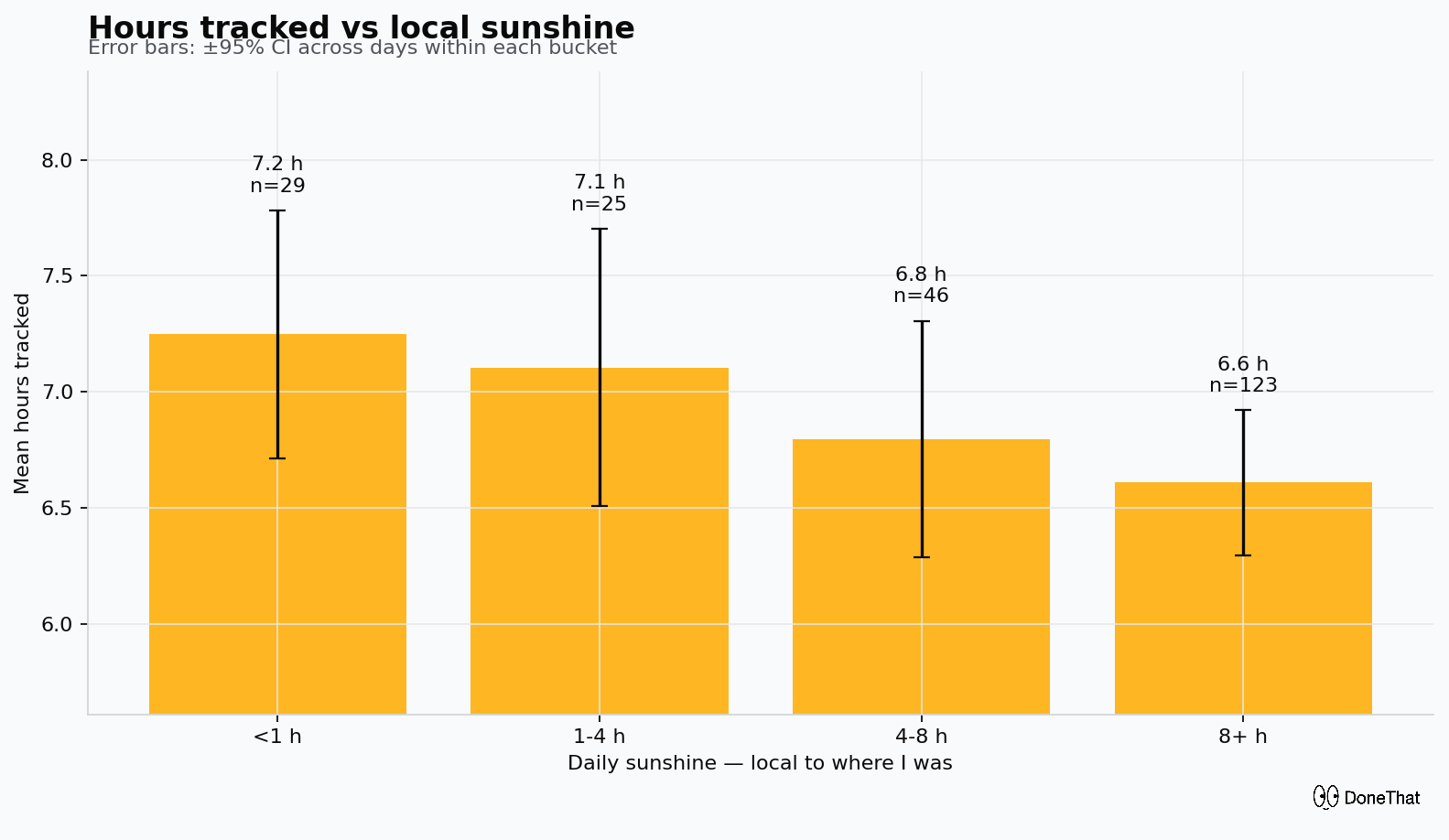
It also works for sunshine by the way, and of course those two are correlated. This might be because in Amsterdam we really don’t get a lot of that, so whenever there is a bit of sun, we all stream outside and go for walks to soak it in.
Workouts make for a better day
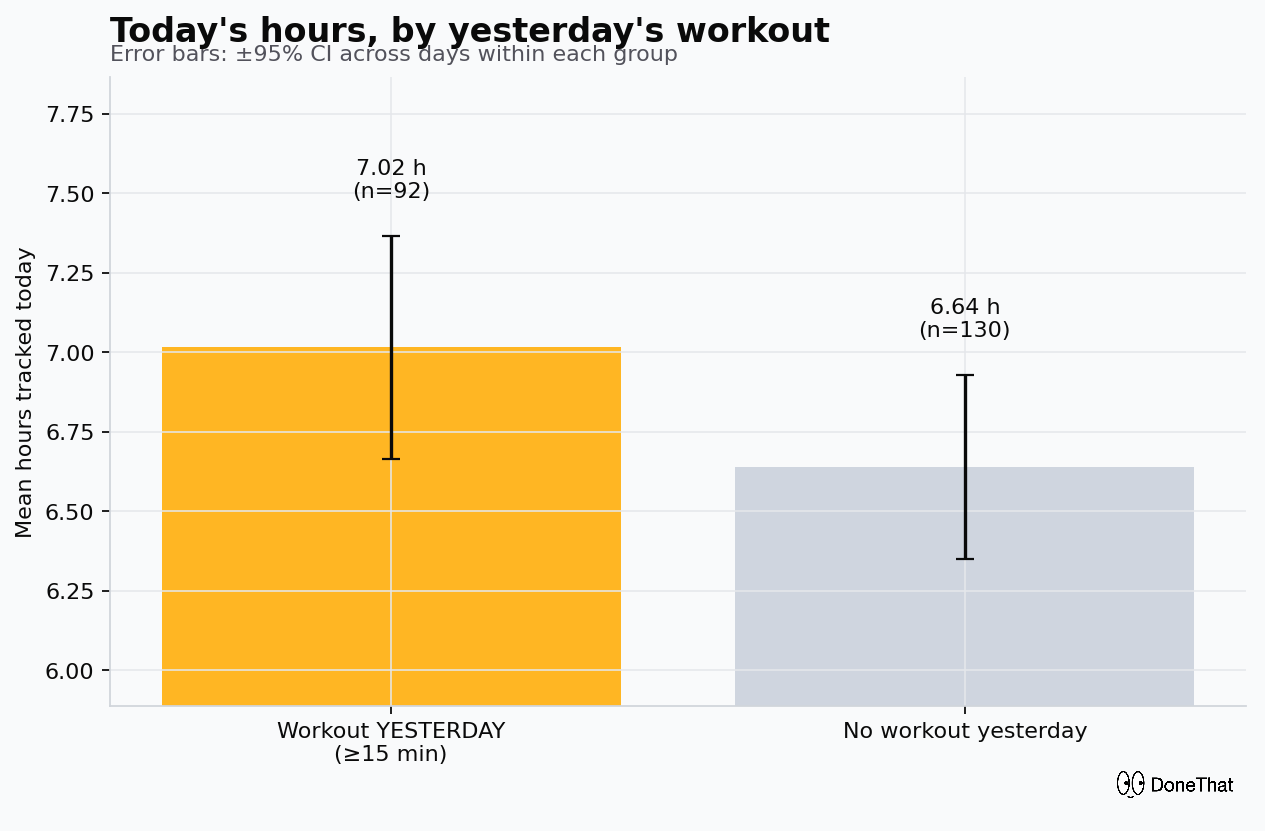
I do my workouts in the evenings usually. Some gym, some spinning, some yoga. Turns out that that is at least a little bit predictive of my productivity the next day, great motivator for keeping those!
Location changed the workday
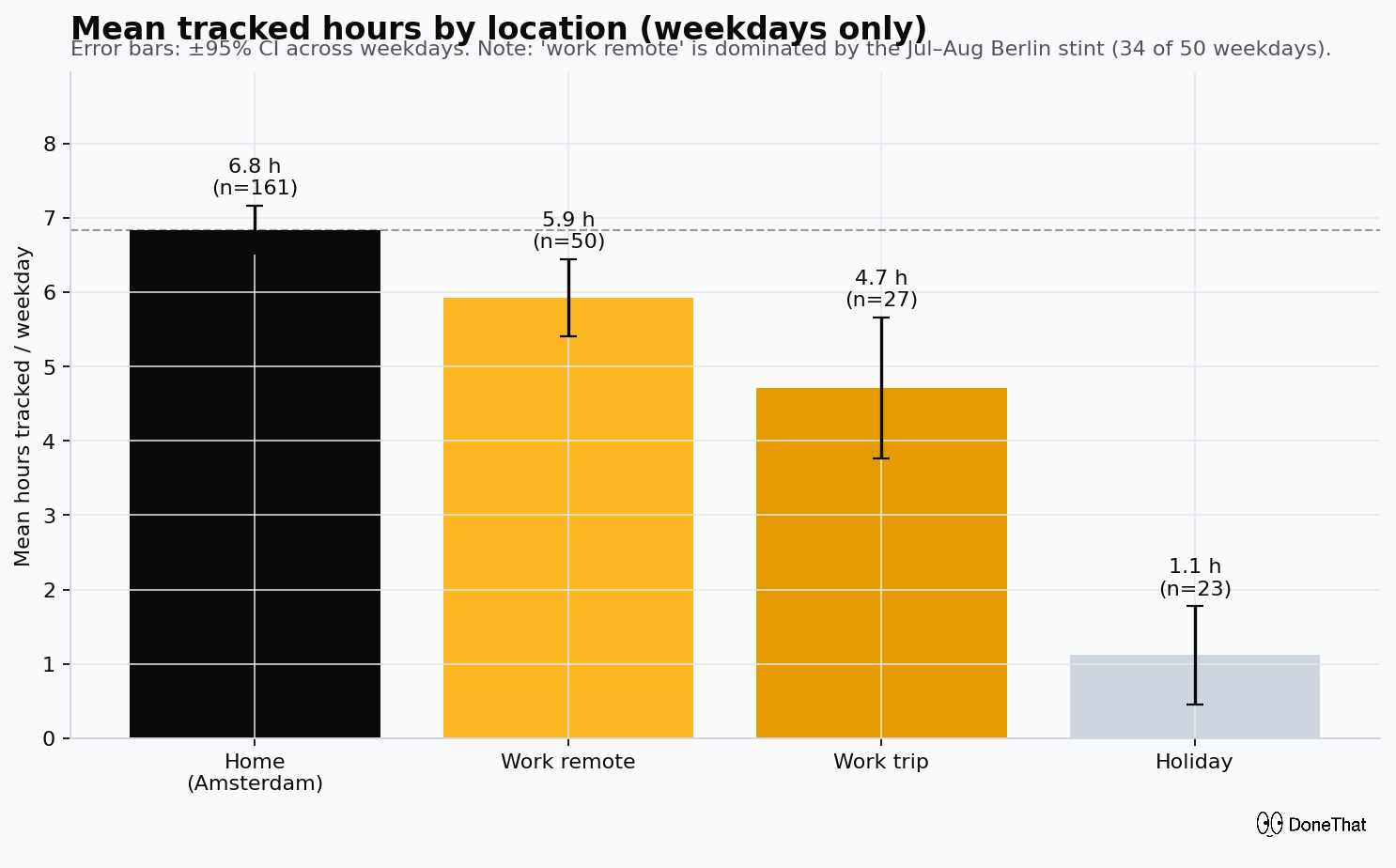
This is probably not a surprise to most people: Working from home is most productive for me. Whenever I am on work trips or working for a week from somewhere else there are always too many distractions. Work trips often include meetings, conferences and I didn’t track those here.
So: What makes for a productive day?
The answer is as boring as it’s true:
- Don’t work too much the day before
- Do a workout the day before
- Get up early
- Focus on the most important stuff in the morning
- Minimize travel
- Take holidays when it’s warm
That’s for me, anyway. Everybody is different. Want to track your own time? Try DoneThat or one of our competitors. You can also see my
What the data doesn’t show
Of course this analysis has lots of limitations: The biggest one is that this is looking at inputs, not outcomes. I’d love to track outcomes, I could for example track revenue and try to correlate this but that won’t work for obvious reasons.
I do believe that for this work, and most other work, you just have to consistently show up every day, do the most impactful thing you can think of, and repeat again the next day. This is input-based but, but that’s what I can control, so that’s what I’m measuring.
Ready to double your productivity?
Insights from your actual week, not generic hacks. It runs quietly so you're not managing another system.
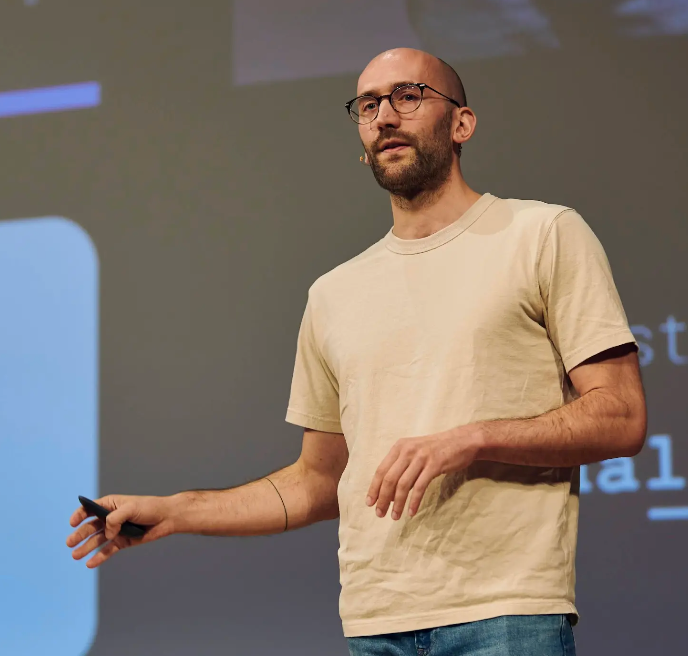
Christoph Hartmann
Christoph is the founder of the AI productivity startup https://donethat.ai . He has over fifteen years experience in AI, including a PhD, a stint at BCG, and as a CTO for a...
View author profileRelated posts
Trace the Work. Calendars Are Not a Log.
Rahul Vohra found 6-7% of his week on craft work a calendar would never have shown. A calendar is intention. A switch log is the trail. Microsoft telemetry explains the gap, and memory is not a backup.
Why You Cannot Categorize Time From Memory
Reconstructing how you spent a week from memory or a calendar fails. Sam Corcos logged 17,784 hours and still would have put recruiting at 20% instead of 3%. Contemporaneous logs plus a small category set is the practice.
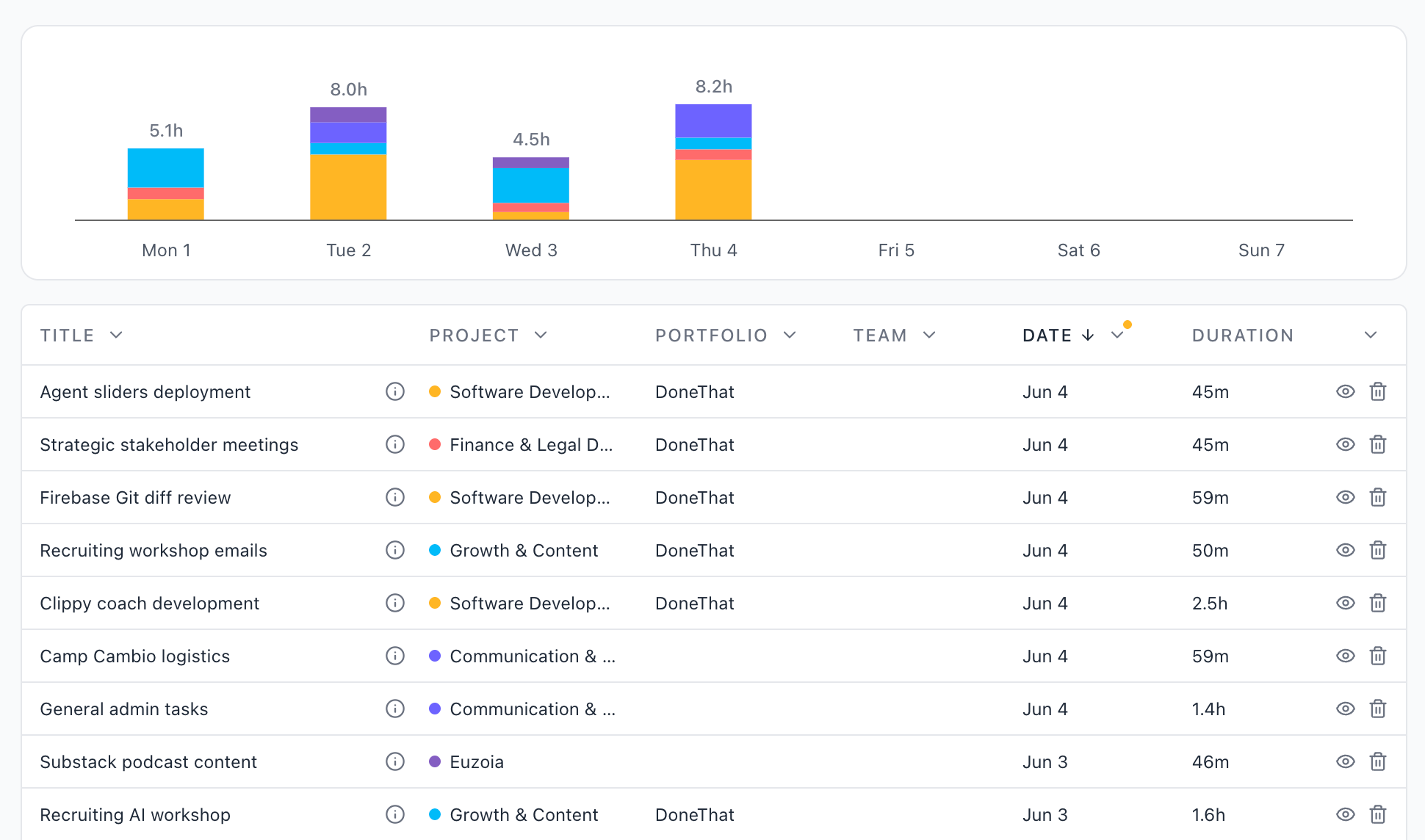
You should probably track your time (and it just got easier)
Most people in EA know they should track their time but don't, because existing tools are either too much work or not accurate enough. Here's why it's worth doing and a new AI-powered option that fixes both.