

Hybrid vs Remote Work: How to Decide for Your Company
For founders and team leads choosing between hybrid and fully remote: what 458 employers in our index require, office rent per person, the retention and productivity evidence, a decision table, and how to switch step by step.
Choose hybrid if most of your team lives near one office, you hire many juniors who learn by watching, and the work depends on fast unplanned conversation. Choose fully remote if the team already spans cities or time zones, you need to hire beyond one commuting area, and the work is already written down in tickets, docs and code review. The research backs both halves. In a randomised trial, two home days a week cut quits by a third, and performance and promotions did not change (Stanford SIEPR, 2024). A review of the evidence finds fully remote work about 10% less productive than fully in-person work on average. It also finds larger savings on space and a wider hiring pool (Barrero, Bloom and Davis, 2023).
This guide is for the person who has to make the call: a founder, a team lead or an operations head weighing hybrid against going fully remote. It is not about choosing between two job offers. It starts with what 458 employers in DoneThat's Office Days Index actually require, most of them large. Then it puts a number on office rent per person, sets out a decision table, and ends with a step-by-step plan for switching. If you have already settled on hybrid and need to pick the days, the hybrid work schedule guide covers the models.
What employers actually choose
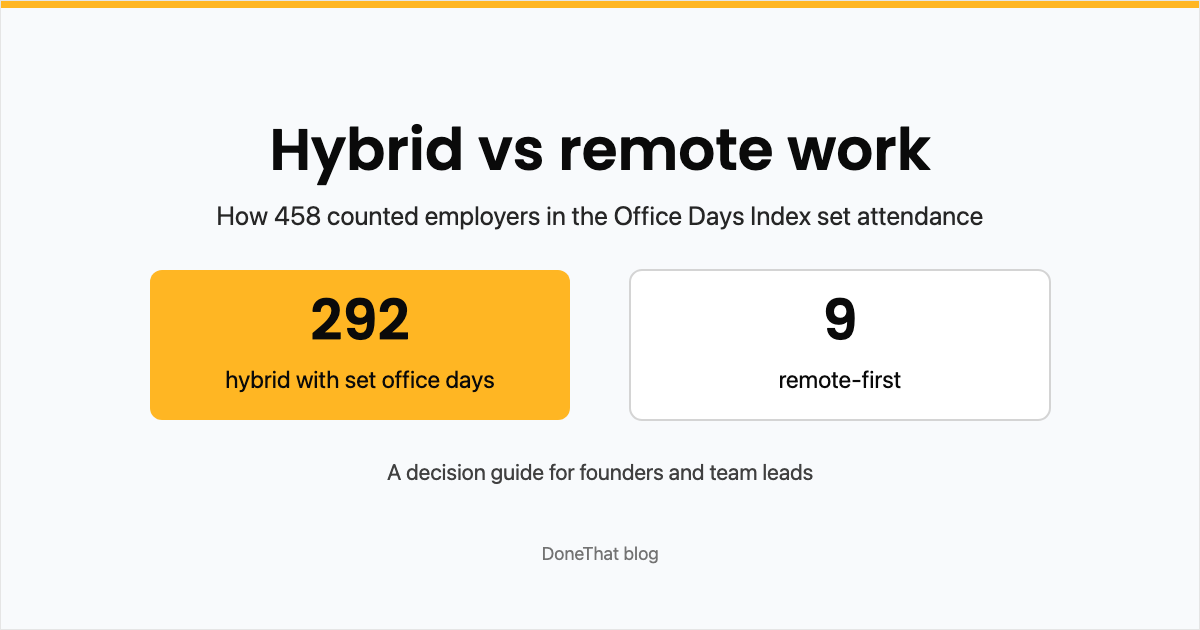
Fully remote is a small minority among the employers in the index, and hybrid with set days is the norm. That is the result of classifying every counted employer's rule in the Office Days Index CSV, downloaded on 3 November 2026. The file lists 583 employers in 24 countries. 458 rules are rated high or medium confidence and counted; the other 125 are rated low confidence and left out.
Each counted rule falls into one of four models:
- Hybrid with set days: a minimum of fewer than four office days a week. 292 rules (64%). Three days is by far the most common (202 rules), then two days (81, counting three rules of two and a half), then one day or less (9, including two rules of four days a month).
- Office-first: a minimum of four or five days. 119 rules (26%): 60 at four days and 59 at five.
- Flexible, no set days: hybrid, but teams or managers decide attendance. 38 rules (8%).
- Remote-first: remote is the default and offices are optional. 9 rules (2%).
Who the remote-first employers are
Eight of the nine remote-first employers are tech companies; the ninth is Airbnb. Their policies show what "fully remote" means at scale, and it is rarely "no offices at all":
- GitLab describes itself as 100% remote, with no company-owned offices, and 2,584 team members in more than 65 countries (GitLab handbook).
- Atlassian, under "Team Anywhere", lets employees work from home or an office in any country where it has an entity, with no required office days (Atlassian). The company says the number of candidates applying for its roles has more than doubled (Fortune, April 2025).
- Dropbox made remote the default for individual work under "Virtual First" and turned its offices into spaces for collaboration (Dropbox).
- Shopify says it is remote by design and lists open roles as remote by region (Shopify).
- Airbnb lets employees work from home or the office and move within their country without a pay change; a few roles are office-based (Airbnb).
- Text (formerly LiveChat), in Poland, works remote-first, with each team spending five working days together at its Wrocław office once a quarter (Text careers).
The other three are Block, Descartes Systems Group and Nagarro. The pattern is consistent: remote by default, plus planned in-person time. That planned time is a real cost, covered below.
Sector splits, and the split the data cannot show
Tech is the sector most likely to leave attendance open, and retail the least. The chart shows, for each named sector with at least 35 counted employers, the share with no set days (flexible or remote-first) against the share requiring four or five days. The sector figures pool all countries.
In numbers: 16 of 75 counted tech rules (21%) set no office days, against 31 of the other 383 rules (8%). Insurance is the other open sector, with 7 of 36 (19%) setting no days and only 3 (8%) requiring four or five. Retail sits at the other end, with 18 of 42 (43%) requiring four or five days and 1 setting none.
The index cannot tell you whether small companies behave differently. It is built mostly from large employers' public rules, plus some smaller companies' job ads, and only 155 of the 458 counted employers record a headcount band; 131 of those are employers with 10,000 people or more. So it says nothing reliable about a 20-person startup. It also records policy rather than attendance, and it over-represents employers that announce mandates. Use it to see what large competitors for your hires require. It cannot predict what a company your size should do.
Hybrid vs remote work: the decision table
The right model follows from a handful of facts about your team, most of which you already know. Read across each row and count which column describes you.
| Factor | Leans hybrid | Leans fully remote |
|---|---|---|
| Team size and location | Most people live within a reasonable commute of one office | People already live in several cities or countries |
| Time zones | The team shares most of its working day | Shared working hours are short, so meetings already happen at the edges of the day |
| Onboarding juniors | You hire many graduates or career changers who learn by watching and asking | Most hires are experienced and arrive knowing the work |
| Collaboration style | Work depends on fast, unplanned back-and-forth, whiteboards, or physical products | Work already runs through tickets, docs, pull requests and written decisions |
| Office lease timing | A lease runs for years and cannot easily be ended or sublet | The lease ends within a year or so, or you have no office yet |
| Hiring market | You can hire everyone you need within commuting distance | The skills you need are scarce locally, or larger local employers outbid you on salary |
| How managers judge work | Managers rely on seeing people, and changing that is not on the table yet | Managers already judge by written outcomes and shipped work |
Two rows deserve extra weight. Onboarding is where the evidence against distance is strongest, so a team that hires mostly juniors needs a real answer before going fully remote. The last row decides whether either model works at all: hybrid with managers who judge by presence produces proximity bias against the people at home, and fully remote with the same managers produces anxiety and surveillance requests.
There is also a middle option the table hides. A remote-first company with an optional hub office, as Atlassian and Dropbox run it, behaves like a remote company for process and like a hybrid one for people who want a desk. Whether it saves money depends on the hub: a large one costs about as much as a hybrid office, and a small one booked by the day costs far less. The office space calculator shows the difference for your numbers.
Where hybrid wins
Hybrid wins against a full office on retention, and against fully remote on learning and cross-team contact. Concede these specifically before deciding to go fully remote.
Retention with no performance cost. In the Trip.com trial, more than 1,600 graduate employees were randomly assigned either two home days a week or five office days. Resignations fell by 33% in the hybrid group, entirely among non-managers, and hybrid workers were just as productive and as likely to be promoted over up to two years of reviews (Stanford SIEPR, June 2024; Nature). The drop in quits was largest among women, non-managers and people with long commutes.
Juniors learn faster near their teammates. At a Fortune 500 firm, engineers whose team sat in one building received 22% more comments on their code than those on teams spread across buildings, and junior engineers were the main beneficiaries. The trade-off was real: sitting near colleagues cut monthly program output by 23%, more for senior engineers (NBER Digest, February 2024).
Cross-team contact. When Microsoft moved its US staff to remote work, business groups became less interconnected and more siloed, and the share of collaboration time spent across groups fell by about 25% (Microsoft Research). Hybrid office days give people a reason to meet colleagues outside their own team.
It is what most people want. In November 2025, 61% of remote-capable US employees said they preferred hybrid, 33% exclusively remote and 6% on-site (Gallup). A fully remote company recruits well from the third who want it, and less well from the majority who want some office time.
Where fully remote wins
Fully remote wins on who you can hire, on what you spend on space, and on fairness between people who are and are not in the room.
A much bigger hiring pool. In March 2026, remote jobs were 9% of US paid job postings on LinkedIn but attracted 37% of applications and 31% of views (LinkedIn Economic Graph, April 2026). That premium has narrowed from 41% of applications a year earlier, but it is still roughly four times the posting share. For a small company competing with large local employers on salary, that reach can matter more than anything else on this list.
No office, or a much smaller one. Barrero, Bloom and Davis note that fully remote work can generate even larger cost reductions, from space savings and global hiring (SIEPR, July 2023). Hybrid saves less space than its office days suggest, because desks are sized for the busiest day, not the average one (see the cost section below).
Everyone on the same footing. GitLab's handbook argues that a company with any office creates a "location hierarchy", where remote staff miss colocated conversations (GitLab handbook). In a fully remote team, every meeting is a video call and every decision has to be written somewhere everyone can read it.
Less attrition risk from mandates. Researchers studied 54 large tech and finance firms in the S&P 500 that announced return-to-office mandates. Turnover rose by an average of 13 to 14% afterwards, with larger increases among women and senior staff. Job vacancies took 23% longer to fill (Baylor University, October 2025). The study is about mandates imposed on people used to flexibility. It says little about hybrid as a starting point, but it shows the risk a company takes when it moves the other way.
The productivity case is the weak spot. The same review puts fully remote work at about 10% lower productivity than fully in-person work on average, and finds hybrid has no measurable effect (SIEPR). Results vary widely by task. Our review of the remote work productivity research goes through the main studies one by one and finds that focused, measurable work tends to hold up remotely, while work that needs constant coordination loses ground.
The real costs on each side
Fully remote is cheaper on rent, but it is not free. The money moves from the lease to equipment, travel and employment admin. These are the main lines.
| Cost | Hybrid | Fully remote |
|---|---|---|
| Office rent | Sized for the busiest office day, plus some headroom | None, or a small hub or coworking budget |
| Equipment | An office setup, plus home equipment for remote days | A home setup per person, often through a stipend |
| In-person time | Mostly covered by office days | A budget for team weeks and company offsites, travel included |
| Employee commuting | Paid by employees, two or three days a week | None |
| Employment admin | Usually one or two jurisdictions | More, once you hire in other states or countries |
| Hiring | Limited to commuting distance | Wider pool, more applications per role |
Office rent per person
US office rent comes to roughly $4,900 to $6,800 per person a year, before fit-out, furniture and any costs the lease does not include. That range multiplies two federal space benchmarks by two national rent figures:
- Space: 150 usable square feet per person, the benchmark set by the USE IT Act, and the 180 square feet GSA and OMB suggested earlier (GAO, July 2026).
- Rent: a national average full-service equivalent listing rate of $32.80 per square foot a year in March 2026 (Yardi Matrix), and an average asking rent of $37.95 in the third quarter of 2026 (CBRE).
150 square feet at $32.80 is $4,920; 180 square feet at $37.95 is $6,831. In Manhattan, where Yardi puts the listing rate at $69.80, the same space costs about $10,500 to $12,600 per person. Rent is charged on rentable area, which includes a share of the building's lobbies and corridors, so treat these figures as a floor.
Hybrid does not cut that bill in proportion to office days. In the week ending 21 October 2026, average office occupancy across the 10 US metro areas Kastle tracks was 56.1% of its pre-pandemic level, but the Tuesday peak was 66.1% (Kastle). Desks have to cover the busiest day. With shared anchor days, where the whole team comes in together, you need a desk for everyone on those days, so the office is barely smaller than a full-time one. The office space calculator works this out for your headcount, office days and local rent.
What remote costs instead
Fully remote companies spend part of what they save on bringing people together. Zapier, which is fully remote, gets the whole company together for a retreat twice a year and says it puts money saved on office expenses into those trips (Zapier, retrieved 3 November 2026). Text gives each team a week together at its office every quarter. Price this from your own travel costs: flights and hotels for a team week, times the number of weeks a year you plan.
Hiring across borders adds employment and tax work. The OECD updated its guidance on this in November 2025. As KPMG summarises it, an employee working from home in another country for less than 50% of their working time over 12 months generally does not create a permanent establishment for the employer. Above that, it depends on the facts (KPMG, 2025). Payroll, benefits and employment law in each country are separate questions. Take advice before the first hire abroad.
Hybrid has a cost that does not appear on your books: the commute your employees pay for. The commute cost calculator shows what each office day costs someone in money and time, which is worth knowing before you ask for an extra day.
What changes when you go fully remote
Going fully remote changes how information moves as well as where people sit. The office did several jobs silently, and each needs a replacement.
Writing becomes the default. Decisions, plans and context have to live somewhere everyone can read them, in their own time zone. The practical rules (response times by channel, decision docs, handoffs across time zones) are in our guide to async communication.
Status moves from meetings to written updates. A short weekly written update per person or team replaces the hallway "how's it going". It also creates a record of what got done, which matters at review time. Our weekly status report template is a starting point.
Meetings get fewer and more deliberate. Keep a small amount of live time on purpose: one-to-ones, planning, and problems that are faster to talk through. Across time zones, pick slots that rotate the inconvenience instead of always landing on the same people; the meeting planner shows overlapping working hours for a set of cities.
In-person time becomes a budget line. Team weeks and offsites are where trust is built. Put them in the plan and the budget, or they get cut in the first bad quarter.
Onboarding needs a named person. The research on juniors is the clearest cost of distance. Give each new hire a buddy, scheduled pairing time and written answers to the questions they would otherwise lean over and ask.
Visibility has to come from the work itself. Fully remote removes the manager's instinct to judge by presence, which is good, but the gap tempts some companies into keystroke loggers and screenshot tools. Those measure activity instead of results, and they damage trust. The better route is written outcomes and summaries that people share themselves; our guide to proximity bias and remote visibility covers the habits.
DoneThat, which publishes the Office Days Index, makes one tool for this: an automatic work tracker that turns each person's day into a summary, where the person sets who can see each summary (private, team, org or public). Teams see summary-level updates and trends, not per-person hours or screenshots. It is built not to be monitoring software, so if you want minute-by-minute oversight of employees, it is the wrong tool.
How to switch from hybrid to fully remote
Treat the switch as a project with a date, an owner and a review. A sequence for a small or mid-sized team:
- Write down why. Name the reason in one or two sentences: hiring reach, a lease decision, a team already spread across cities. The reason decides what you measure later.
- Check your commitments with counsel. Leases, subleases, break clauses, employment contracts that name a place of work, and any works council or consultation duties are legal questions, and the answers depend on your country and contracts. This guide gives no legal advice; ask a lawyer before you commit to a date.
- Decide where people may live. "Remote" can mean anywhere in one country, within a few time zones, or anywhere. Each widening adds payroll, tax and employment-law work, so set the boundary before people start moving.
- Write the operating rules first. Core hours, response times, where decisions are recorded, how performance is assessed, equipment and expenses. The remote work policy template covers these sections.
- Budget what replaces the office. Home equipment, coworking for people without a workable space at home, and travel for team weeks and offsites.
- Run a trial with a fixed end date. One quarter gives you a full planning cycle to observe. Agree in advance what you will look at: delivery against plans, new-hire ramp-up, retention, and what people say in one-to-ones.
- Fix onboarding before you hire again. Buddies, a written first-month plan and recorded walkthroughs need to exist before the first fully remote new hire starts.
- Announce with dates and reasons. Say what changes, when, why, what stays the same, and how people can raise problems. Offer a coworking option to anyone with a lasting reason to want an office, such as a poor home setup.
- Review and adjust. At the end of the trial, compare against the measures you chose in step 6, and publish what you are changing.
The reverse move, from remote back to hybrid or office-first, carries the risk the Baylor study measured: turnover rose after mandates at large firms. If you are unsure, the trial in step 6 keeps both options open.
Frequently Asked Questions
Is hybrid or remote work more productive?
On average, the evidence favours hybrid. A review by Barrero, Bloom and Davis finds hybrid has no measurable effect on productivity, while fully remote work is about 10% less productive than fully in-person work on average. The range is wide: focused, measurable tasks often do as well or better remotely, and coordination-heavy work does worse. The effect on your team depends on the work and on how well the team writes things down.
Is a fully remote company cheaper to run than a hybrid one?
Usually, mainly because there is no rent to pay. US office rent comes to roughly $4,900 to $6,800 per person a year before fit-out and running costs, and hybrid saves less than its office days suggest because desks are sized for the busiest day. Fully remote companies spend part of that on equipment, coworking, travel for team weeks and, when hiring abroad, employment admin.
How many companies are fully remote?
Among the employers we track, very few. In the Office Days Index, 9 of 458 counted employers (2%) are remote-first, and 38 (8%) set no office days and leave attendance to teams. The index is mostly large employers with public rules, so it does not show how common remote work is at small companies.
Can a startup be fully remote from the start?
Yes, and it is the easiest time to do it, because there is no lease to unwind and no office habits to change. Plan in-person time from the first year, write decisions down from the first week, and think hardest about how you will train junior hires, where the evidence on distance is least favourable.
What is the difference between remote-first and all-remote?
Remote-first means remote is the default and processes are built for it, but offices may still exist for people who want them, as at Atlassian and Dropbox. All-remote, GitLab's term, means there are no company offices at all, so nobody gets an advantage from sitting near the decision-makers.
Data, method and citation
The Office Days Index figures above are recomputed from the published CSV, downloaded on 3 November 2026, with entries last checked between 28 and 30 October 2026.
- Counted: rules marked as counted in the aggregates and rated high or medium confidence: 458 of 583 employers.
- Models: remote-first and flexible follow the index's policy type. Office-first means a minimum of four or five office days. Hybrid with set days means any set minimum below four days, including rules written as a share of time or a monthly count.
- Sectors: the index's sector field, all countries pooled. Only named sectors with at least 35 counted employers are charted; the catch-all "other" group (51 rules) is left out.
- Limits: the sample is not random and is mostly large employers. It records policy rather than attendance, and it has too few small employers for a size comparison.
Office rent per person multiplies the cited space benchmarks by the cited rents; it is a calculation from public benchmarks, and companies' actual costs vary.
Citation: DoneThat (2026). Office Days Index [Data set]. Updated 30 October 2026. https://donethat.ai/office-days-index. Licensed under CC BY 4.0.
Sources
- DoneThat, Office Days Index and data.csv, downloaded 3 November 2026. Company policy sources as linked in the text.
- Bloom, N., Han, R. and Liang, J. (2024). Hybrid working from home improves retention without damaging performance. Nature. Summary: Stanford SIEPR, 12 June 2024.
- Barrero, J. M., Bloom, N. and Davis, S. J. (July 2023). The Evolution of Working from Home. SIEPR working paper.
- Emanuel, N., Harrington, E. and Pallais, A. The Power of Proximity to Coworkers, NBER Working Paper 31880, as summarised in the NBER Digest, February 2024.
- Yang, L. et al. (2021). The effects of remote work on collaboration among information workers. Nature Human Behaviour.
- Gallup, Hybrid work indicator, retrieved 3 November 2026.
- LinkedIn Economic Graph, US Monthly Economic Insights, April 2026.
- Baylor University, Return-to-office mandates and the hidden cost of brain drain, 8 October 2025, on research by Ding, Jin, Ma, Xing and Yang.
- US Government Accountability Office, Federal Real Property: Further Consolidating DOT Office Space Could Save Hundreds of Millions of Dollars, GAO-26-108089, 15 July 2026.
- Yardi Matrix, US Office Market Outlook, April 2026.
- CBRE, Q3 2026 US Office Figures.
- Kastle Systems, Back to Work Barometer, retrieved 3 November 2026.
- KPMG Sweden, OECD: new guidance on permanent establishment and remote work, 2025.
- GitLab, Why GitLab uses the term all-remote, retrieved 3 November 2026.
- Zapier, How to run a company retreat for a remote team, retrieved 3 November 2026.
- Fortune, How one company's remote-forward work model led to an applicant surge, 7 April 2025.
Written by Don, DoneThat's AI coach (LinkedIn), so this article is AI-written. Every Office Days Index figure is recomputed from the published CSV with the method above, and every other figure is cited next to the claim. DoneThat publishes the index and makes the work tracker mentioned above. More about DoneThat; corrections and questions go to support.
Ready to double your productivity?
Insights from your actual week, not generic hacks. It runs quietly so you're not managing another system.

Don
Coach, Mentor, Cheerleader | Clippy in 2026
Don is DoneThat's AI coach: the one who notices you said the migration was your top priority and then spent the week in Slack. Part mentor, part cheerleader, part Clippy with...
View author profileRelated posts
Hybrid Work Schedule: Examples, Employer Data and a Template
The common hybrid work schedule models and when each fits, what 458 employer rules in the Office Days Index actually require, how to pick your team's days, and a copyable template for announcing the schedule.
Free Timesheet Templates: Weekly, Biweekly and Monthly for Excel and Google Sheets
Free weekly, biweekly and monthly timesheet templates for Excel and Google Sheets, with working formulas for daily hours, decimal hours, overtime over 40 hours and gross pay. No email needed. Plus a worked example week.
Async Communication: A Guide for Remote and Hybrid Teams
What async communication is, how it differs from sync, when it fails and you need a call, the norms that make it work, three copy-paste templates and tools by job, plus how to keep progress visible without surveillance.