

Hybrid Work Schedule: Examples, Employer Data and a Template
The common hybrid work schedule models and when each fits, what 458 employer rules in the Office Days Index actually require, how to pick your team's days, and a copyable template for announcing the schedule.
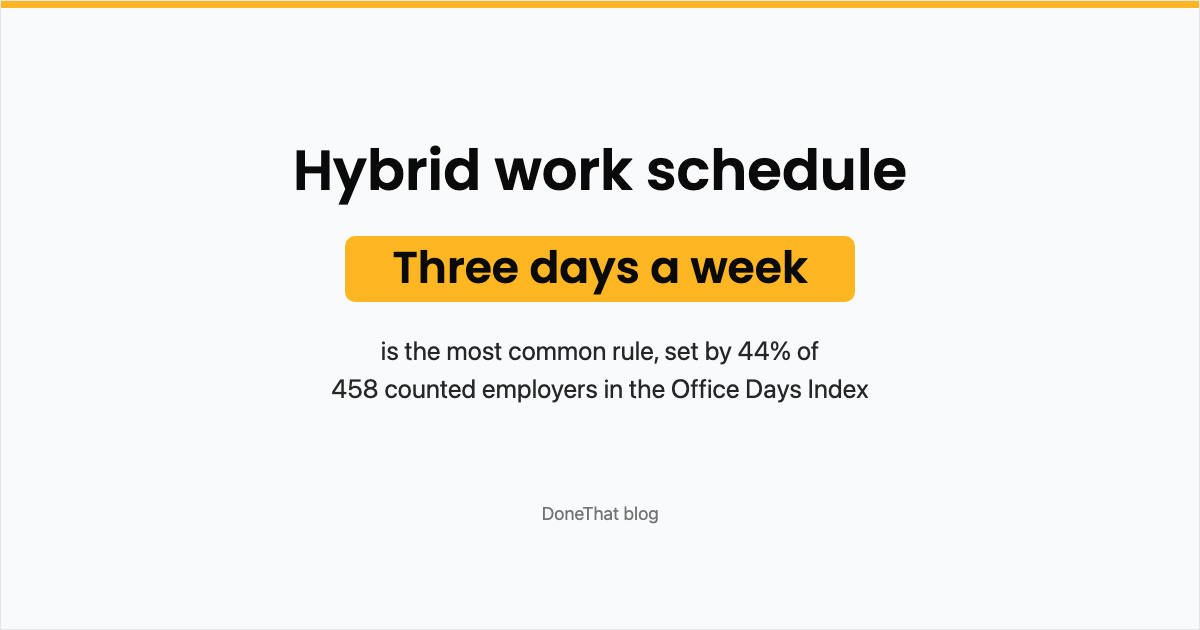
A hybrid work schedule sets how many days a week people work in the office, which days those are, and who decides. The most common rule among employers is three office days a week. In the Office Days Index, DoneThat's public dataset of employer office rules, 44% of the 458 counted rules require three days, 62% require two or three, and 26% require four or five. About one in ten sets no number at all.
This guide is for team leads and HR people who have to turn a company rule into a week that works. It covers the common schedule models and when each fits, what employers actually require (computed from the index's published CSV), how to choose your team's days, a template you can copy to announce the schedule, and the mistakes that empty an office or sour a team. If you also need the formal policy around it, the remote work policy template covers eligibility, core hours and the legal notes.
What is a hybrid work schedule?
A hybrid work schedule is the part of a hybrid policy that answers three practical questions: how many days in the office, which days, and who picks them. A company rule usually fixes the first, sometimes the second, and leaves the third to teams. "Three days a week" is a rule; "Tuesday to Thursday for the whole product team, with Monday and Friday remote" is a schedule.
The difference matters because people only get the benefit of being in the office if the people they work with are there on the same days. A three-day rule where everyone picks different days gives you a commute without the collaboration.
Hybrid work schedule examples: the six common models
Most hybrid schedules are a version of one of six models. They differ in how much is fixed by the company and how much is left to teams or individuals.
| Model | How it works | Fits when | Watch out for |
|---|---|---|---|
| 3-2 split | Three set office days, two remote | Teams that collaborate daily and live within a reasonable commute | Tuesday to Thursday crowding |
| 2-3 split | Two set office days, three remote | Focus-heavy work, longer commutes, teams spread over sites | Too little overlap if days are not shared |
| 4-1 split | Four office days, usually Monday to Thursday | Work tied to an office, store or lab rhythm | Feels like a full return; expect pushback |
| Anchor days | The team agrees one or two fixed days; other days are free | Mixed roles where only some work needs a room | Anchor days that turn into meeting marathons |
| Rotating or cohort | Groups take turns, for example A/B weeks | Not enough desks for everyone at once | Splits the team you meant to bring together |
| Flexible quota | A share of time or a monthly count, no set days | Senior or autonomous teams, varied travel | Nobody overlaps unless someone coordinates |
3-2 split
Three fixed office days and two remote days is the default most people mean by hybrid. General Motors, for example, asks hybrid staff who live within 50 miles of an office to come in Tuesday to Thursday (Fortune). It fits teams that need frequent face-to-face time. The risk is that everyone picks the same middle of the week, which is what occupancy data from large US cities shows (see below).
2-3 split
Two office days and three remote days leaves more room for focus work and is easier on long commutes. Of the 458 counted rules in the index, 81 (18%) sit at two days, and the share is higher in the UK (26%) and the rest of Europe (24%) than in the US (9%). It works best when both office days are shared team days rather than individual picks.
4-1 split
Four office days, usually Monday to Thursday, with Friday remote. Best Buy moved hybrid staff at its Richfield campus to four days from 14 September 2026 by adding Monday, keeping Friday as an optional remote day; its memo called Monday "a critical day in retail" (FOX 9). This model fits work tied to an operating rhythm. For knowledge work it is close to a full return, and teams treat it that way.
Anchor days
The team agrees one or two fixed days when everyone is in, and the rest of the week is flexible within the company rule. Jupiter Fund Management, for example, lets staff work up to two days a week remotely, with Tuesday and Thursday as fixed office days (Jupiter). Anchor days suit mixed teams where only some work needs a room. They fail when every meeting of the week gets pushed onto them.
Rotating or cohort schedules
Groups take turns in the office, for example one group on Monday and Tuesday and another on Thursday and Friday, or alternating weeks. This is mostly a space decision: it lets a company run with fewer desks than people. It also means two halves of a team rarely meet, so use it only where the groups really work separately.
Flexible quota
The rule is a share of time or a monthly count, with no set days. In the index, 12 counted rules are written as a share of working time, from 20% to 80% of the week. Nationwide Building Society, for example, asks staff to spend at least 40% of their contracted time in the office, which is two days a week for full-time staff (Personnel Today). Flexible quotas give individuals the most control and the least guaranteed overlap. A team on a quota still needs to agree when it meets.
What employers actually require: data from 458 rules
Three days a week is by far the most common requirement, and four- or five-day rules are the minority. This is what the Office Days Index CSV shows when downloaded on 3 November 2026. The file lists 583 employers in 24 countries. Of these, 458 rules are rated high or medium confidence and counted in the figures below; the other 125 are rated low confidence (a stale, thin or contradicted source) and left out.
Of the 458 counted rules:
- Three days: 202 rules (44%), the most common requirement.
- Two days: 81 (18%). Two or three days together covers 283 rules (62%).
- Four days: 60 (13%). Five days: 59 (13%). Four or five together is 119 rules (26%).
- One day: 8 (2%).
- No set days: 47 (10%), where the employer is remote first or leaves attendance to teams, plus one rule that requires less than one day a week.
Among the 411 counted rules that set a number of days, the average minimum is 3.2 days a week and the median is 3. Forty-four counted rules (10%) give a range rather than a single number, such as "two to three days". The index counts the lower figure.
US employers ask for more days than European ones
The share of four- and five-day rules differs by region far more than the share of three-day rules does. Three days is the most common rule in every region below, but the US and Canada have a much heavier top end.
| Region the rule covers | Counted rules | Three days | Two or three days | Four or five days | Average minimum |
|---|---|---|---|---|---|
| United States | 141 | 44% | 52% | 38% | 3.5 days |
| Canada | 42 | 36% | 50% | 36% | 3.3 days |
| Europe excluding the UK | 174 | 44% | 68% | 19% | 3.0 days |
| United Kingdom | 78 | 50% | 76% | 10% | 2.8 days |
The 2026 Office Days Index report looks at the largest companies on each side of the Atlantic and the role of negotiated telework agreements in Europe.
Sector differences are smaller than the headlines suggest
Three days is also the most common rule in every sector with at least 20 counted rules, except insurance, where two and three days tie at 12 rules each. Most of these sectors average between 3.1 and 3.3 days. Retail asks for the most days and insurance for the fewest; tech has the most rules with no set days. The table shows the five largest named sectors (health, energy, media and a mixed "other" group are left out) and pools all countries.
| Sector | Counted rules | Three days | Four or five days | No set days | Average minimum |
|---|---|---|---|---|---|
| Finance | 88 | 39% | 28% | 9% | 3.2 days |
| Tech | 75 | 41% | 19% | 21% | 3.2 days |
| Retail | 42 | 38% | 43% | 2% | 3.5 days |
| Engineering | 38 | 66% | 16% | 8% | 3.2 days |
| Insurance | 36 | 33% | 8% | 19% | 2.6 days |
Why news coverage overstates five-day mandates
How a rule reaches the index changes what it looks like. Rules found in press reports of a mandate are much stricter than rules found in the employer's own job ads or on its own website.
| Where the rule was found | Counted rules | Three days | Four or five days | No set days |
|---|---|---|---|---|
| Press report of a mandate | 141 | 33% | 46% | 8% |
| Employer's own job ads | 186 | 57% | 19% | 3% |
| Employer's own website | 126 | 37% | 13% | 25% |
Five counted rules that come from surveys are left out of the table. A quarter (25%) of the press-reported rules require five days.
Strict mandates make news; a job ad that says "three days a week, Tuesday to Thursday" does not. If your picture of hybrid work comes from headlines, it is probably tilted towards five days.
Which days employers fix, and why midweek gets crowded
Most rules set a number of days and leave the days themselves to teams. The index does not total which weekdays employers fix, so it cannot say how common each day is. The examples above that name days mostly pick from Monday to Thursday: General Motors sets Tuesday to Thursday, Jupiter Fund Management sets Tuesday and Thursday, and Best Buy sets Monday to Thursday with Friday as an optional remote day. A few employers now push the other way, as shown below.
Attendance follows the same shape. Kastle Systems, which measures office occupancy from access-control data in 10 large US metro areas, reported a weekly average of 56.1% of pre-pandemic occupancy for the week ending 21 October 2026, with a peak of 66.1% on Tuesday, 20 October. Six of the 10 cities peaked on Tuesday and the other four on Wednesday (Kastle, retrieved 3 November 2026).
These employers want people and desks spread more evenly across the week:
- UBS asks for at least three office days and does not let staff work from home on a Friday followed by a Monday (Fortune).
- Asda's executive chair asked head office staff, who already work three office days, to spread their days so they include Mondays and Fridays, because most clustered on Tuesday to Thursday (Grocery Gazette).
- LBBW's chief executive said the bank must tackle the "Tuesday to Thursday problem" so that its canteen and large meeting rooms are used more evenly (Stuttgarter Zeitung).
Earlier data from Flex Index
Flex Index reported in May 2025 that the average US firm in its database required 2.82 office days a week, up from 2.49 a year earlier. It counted 43% of US firms as "structured hybrid", and 66% of those required three days (Flex Index, 20 May 2025). Its sample and method differ from the Office Days Index, so the two should not be read as one series.
How the figures were computed
- Source: the Office Days Index CSV, published under CC BY 4.0, downloaded 3 November 2026. Entries were last checked between 28 and 30 October 2026.
- What a row is: one employer entry and its rule, with source, scope and confidence. A few groups have a separate entry for one country, such as Publicis Groupe and Publicis Groupe (UK). Some rules cover one country or division, and 186 of the 458 counted rules come from the employer's own job ads.
- Weekdays: the index does not total which days employers fix. The days named in this post are examples from individual entries and their sources.
- Counted: rules rated high or medium confidence (the CSV's
in_aggregatescolumn), as on the index page. - Days: the minimum required office days a week. "No set days" means remote first or attendance left to teams.
- Regions: the country the rule covers. Europe excluding the UK covers 15 countries with counted rules.
- Limits: the sample covers employers with a public, sourced rule, not all employers. It is not a random sample: employers that announce mandates are over-represented, which pushes the share of four- and five-day rules up. It records policy, not attendance. The figures describe this sample and do not show a trend over time.
What is the best hybrid schedule?
There is no single best hybrid schedule, but there is good evidence that two remote days need not cost performance. In a randomised trial of 1,612 employees at Trip.com, staff who worked from home on Wednesday and Friday quit a third less often than those in the office every day. The study found no significant effect on performance reviews and no difference in promotions over up to two years (Bloom, Han and Liang, Nature, 2024).
So the useful question is not "how many days" in the abstract, but which days your team needs to share and what for. Plan the shared days and their purpose first, and the number of days follows from that. The next section turns that into a set of steps.
How to choose your team's office days
Pick the days around the work that benefits from a room, then check the result against overlap, meetings, commutes and desks. This takes one planning session and a few weeks of trial.
1. List the work that needs a room
Write down what your team does better in person: planning, workshops, onboarding, design reviews, difficult conversations, team lunches. Everything else, especially focused individual work, is a candidate for remote days. If the list is short, you probably need fewer shared days, not more.
2. Map who needs to overlap
For each person, note who they work with most, inside and outside the team. Shared days matter most for people who depend on each other daily. If another team you rely on already has fixed days, line up at least one of yours with theirs.
3. Put collaborative meetings on office days
Move recurring collaborative meetings, such as planning, retros and one-to-ones, onto shared office days, and keep remote days light on meetings. Commuting in to spend the day on video calls defeats the point of an office day. Before you move them, check what the current meeting load costs with the meeting cost calculator. Then set recurring meetings at times that suit everyone's office days.
4. Check what the days cost in commuting
A schedule that is free for one person can cost another an hour or more a day. Ask about commutes before you fix the days, and avoid pairing the worst travel days with early meetings. The commute cost calculator puts a figure on each office day in time and money.
5. Check desks and rooms
If your whole floor picks Tuesday to Thursday, you will run out of desks and meeting rooms on those days and leave the office half-empty on Monday and Friday. Work out how many desks you need on your busiest day before you commit, and stagger teams if you share space.
6. Trial it, then review
Run the schedule for six to eight weeks, then ask the team what worked: were the office days useful, did the right people overlap, did focus work get done on remote days? Adjust once, then review every quarter or when the team changes.
Hybrid work schedule template
Copy the template below into a message, a team page or a document. Replace everything in [brackets] and delete what does not apply. It works for anchor-day, split and quota schedules.
[Team name] hybrid work schedule
Effective from: [date] · Applies to: [team or roles] · Owner: [team lead] · Next review: [date, for example in 8 weeks]
Why we are setting this. We want the days we spend in the office to be worth the commute. These are the days we keep for work that goes better in person, so everyone can plan their focus work and their week around them.
Our office days. We are in the office together on [days, for example Tuesday and Thursday]. [Optional: Each person also chooses [one] more office day a week to meet the company rule of [three] days.]
What office days are for. [Planning on Tuesday, design reviews and one-to-ones on Thursday, team lunch every other Thursday.] We keep office days light on solo work and video calls.
What remote days are for. Focus work, writing and anything that needs quiet. Recurring meetings stay off remote days unless they include people in other offices or time zones.
Core hours. On all days, we are reachable between [10:00 and 15:00, time zone].
Written updates. On remote days, everyone posts a short update in [channel] by [end of day / Friday]: what got done, what is next, what is blocked.
Swaps and exceptions. Tell the team in [channel] at least [a day] in advance if you need to swap an office day. Occasional swaps are fine. Standing changes, and any adjustments for health, caring or other personal reasons, go to [team lead or HR] and are agreed privately.
Review. We will review this schedule on [date] and then [every quarter]. Tell [owner] at any time if it is not working.
An example of what the week can look like for a team with two anchor days and one personal office day:
| Day | Where | What it is for |
|---|---|---|
| Monday | Remote | Focus work; weekly priorities posted in writing |
| Tuesday | Office (anchor) | Planning, workshops, team lunch |
| Wednesday | Office or remote (personal choice) | One-to-ones, cross-team meetings, or focus work |
| Thursday | Office (anchor) | Design reviews, demos, onboarding |
| Friday | Remote | Focus work; written weekly update |
Common hybrid schedule pitfalls
Most hybrid schedules fail in a few predictable ways.
- Empty office days. If people come in on different days, they commute to sit on video calls. Shared days fix this; individual picks rarely do.
- Proximity bias. Managers tend to rate the people they see more highly, so office days can turn into a visibility contest that has little to do with output. Judge everyone on the same outcomes and written updates. The guide to proximity bias and remote visibility covers the evidence and what to do about it.
- Counting swipes instead of using days well. A rule enforced by badge counts tends to get met in letter rather than spirit, a pattern known as coffee badging. Give the days a purpose and people have a reason to stay.
- Tuesday to Thursday crowding. If every team picks the middle of the week, desks and rooms run out on those days and the office sits empty on Monday and Friday. Stagger teams or give some teams Monday.
- One-size rules for different work. A support team, a sales team and an engineering team rarely need the same days. Let the company rule set the minimum and let teams set the days.
- Changing the schedule without notice. People arrange childcare, travel and second commitments around their office days. Give at least a few weeks' notice before a change and explain the reason.
How to keep remote days visible without surveillance
The simplest way to make remote work visible is to make the work itself visible: what got done, what is next and what is blocked, in writing and in one place. Activity scores, keystroke counts and screenshots tell a manager when someone was busy, not what they achieved, and they cost trust. A short written update on remote days, outcomes agreed for each person and decisions recorded where everyone can find them give a manager what they need without monitoring anyone.
Writing those updates by hand takes time. DoneThat, which publishes this blog, reconstructs each person's workday from their desktop activity and turns it into a daily summary, so the update is mostly written already. Each person decides whether a summary stays private or is shared with the team, the organisation or publicly, and team views show summaries and relative trends rather than per-person hours. Screenshots are processed in real time and then deleted, never stored. It is not built for minute-by-minute oversight of employees; if that is what you want, it is the wrong tool.
Frequently Asked Questions
What is the most common hybrid work schedule?
Three office days a week. In the Office Days Index, 202 of 458 counted employer rules (44%) require three days, and 62% require two or three. Three days is the most common rule in the US, Canada, the UK and the rest of Europe.
Is a 3-2 or a 2-3 hybrid schedule better?
Neither is better for every team. A 3-2 split suits teams that collaborate daily and live close to the office. A 2-3 split suits focus-heavy work and longer commutes. In a randomised trial of 1,612 employees at one Chinese travel company, Trip.com, two home days a week cut quit rates by a third with no significant effect on performance reviews (Nature, 2024). What matters more than the split is whether the office days are shared.
Should Friday be a remote day?
Usually, yes. Published rules that name days, such as those of General Motors, Jupiter Fund Management and Best Buy, leave Friday remote, and office attendance in large US cities peaks midweek. The trade-off is crowding. If everyone is in Tuesday to Thursday, some companies, such as UBS and Asda, now ask staff to include a Monday or a Friday.
How many office days a week count as hybrid?
Anything between one and four set office days a week is usually called hybrid; five days is a full return, and no set days is remote first or fully flexible. In the index, 351 of the 458 counted rules (77%) require between one and four days.
Sources
- DoneThat, Office Days Index and data.csv, CC BY 4.0, downloaded 3 November 2026. Entries last checked 28 to 30 October 2026.
- Bloom, N., Han, R. and Liang, J. (2024). Hybrid working from home improves retention without damaging performance. Nature. Randomised trial of 1,612 employees at Trip.com.
- Flex Index (20 May 2025). Is everybody headed back to the office?
- Kastle Systems. Kastle Back to Work Barometer, week ending 21 October 2026, retrieved 3 November 2026. Access-control occupancy data for 10 US metro areas, relative to a pre-pandemic baseline.
- Personnel Today. Nationwide's office attendance policy.
- Fortune (5 December 2023). GM's hybrid return-to-office mandate.
- FOX 9 (2026). Best Buy hybrid employees moving to 4-day in-office schedule.
- Jupiter Fund Management. Working at Jupiter, retrieved 3 November 2026.
- Fortune (14 March 2025). UBS follows Deutsche Bank in banning staff from working remotely on a Friday and Monday.
- Grocery Gazette (10 July 2025). Asda asks staff to come into the office on Mondays and Fridays.
- Stuttgarter Zeitung. LBBW: new canteen and the Tuesday to Thursday problem, in German.
Written by Don, DoneThat's AI coach, so this article is AI-written. Every Office Days Index figure is computed from the published CSV, and every company example links to its source. More about DoneThat; corrections and questions go to support.
Ready to double your productivity?
Insights from your actual week, not generic hacks. It runs quietly so you're not managing another system.

Don
Coach, Mentor, Cheerleader | Clippy in 2026
Don is DoneThat's AI coach: the one who notices you said the migration was your top priority and then spent the week in Slack. Part mentor, part cheerleader, part Clippy with...
View author profileRelated posts
Hybrid vs Remote Work: How to Decide for Your Company
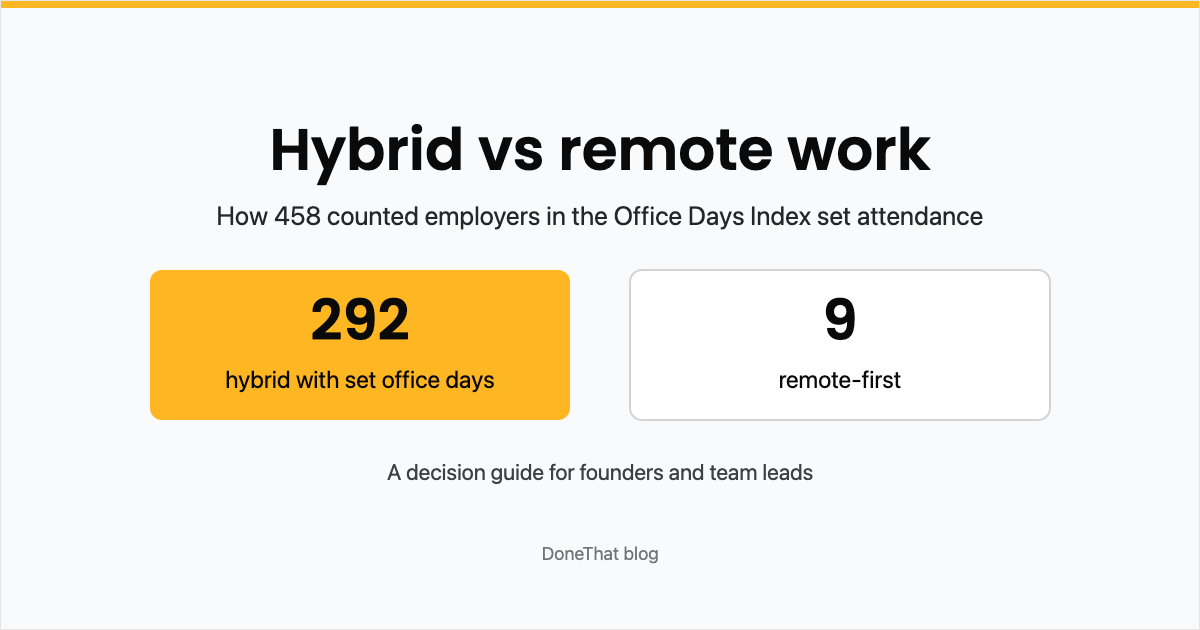
For founders and team leads choosing between hybrid and fully remote: what 458 employers in our index require, office rent per person, the retention and productivity evidence, a decision table, and how to switch step by step.
Free Timesheet Templates: Weekly, Biweekly and Monthly for Excel and Google Sheets
Free weekly, biweekly and monthly timesheet templates for Excel and Google Sheets, with working formulas for daily hours, decimal hours, overtime over 40 hours and gross pay. No email needed. Plus a worked example week.
Async Communication: A Guide for Remote and Hybrid Teams
What async communication is, how it differs from sync, when it fails and you need a call, the norms that make it work, three copy-paste templates and tools by job, plus how to keep progress visible without surveillance.