

How Many Work Hours Are in a Year? 2026 and 2027
A 40-hour work year is 2,080 hours. After US federal holidays, 2026 has 2,000 working hours and 2027 has 1,992. After average paid vacation, 2026 drops to about 1,912. Tables, arithmetic and how to use the number.
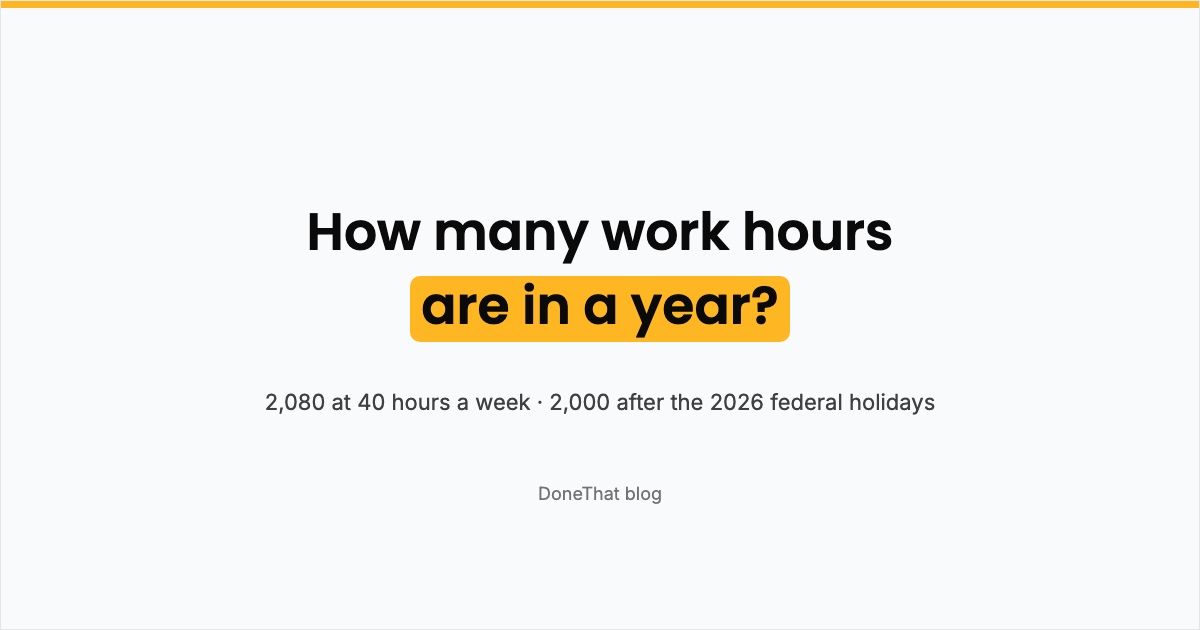
There are 2,080 work hours in a year for a full-time employee on a 40-hour week: 40 hours × 52 weeks. Payroll and HR use that figure to turn a salary into an hourly rate. It treats every week of the year as paid, so it includes holidays and vacation.
The hours you actually spend working are fewer. After US federal holidays, 2026 has 2,000 working hours and 2027 has 1,992. Average paid vacation brings 2026 down to about 1,912. The rest of this page shows the arithmetic, the numbers for other weekly schedules, how the UK and EU differ, and what to do with the result.
The standard work year is 2,080 hours
A standard work year has 2,080 hours. The formula is weekly hours × 52:
- 40 hours a week: 40 × 52 = 2,080 hours
- 37.5 hours a week: 37.5 × 52 = 1,950 hours
- 35 hours a week: 35 × 52 = 1,820 hours
- 20 hours a week: 20 × 52 = 1,040 hours
The 40-hour week is also the threshold US overtime law uses. Under the Fair Labor Standards Act, covered non-exempt employees must be paid at least time and a half for hours worked over 40 in a workweek (US Department of Labor).
For scale, a calendar year has 8,760 hours (365 × 24), so a 2,080-hour work year is about 24% of it.
2,080 is a pay number, not a count of hours at work
The 2,080 figure answers the question of how many hours you are paid for. A salaried employee is paid for Thanksgiving and for a week at the beach, so those hours sit inside the 2,080. To find how many hours you will actually be at work, subtract holidays and leave, which is what the next sections do.
Why 2026 and 2027 have 2,088 weekday hours, not 2,080
Fifty-two weeks are 364 days. A normal year has 365, and a leap year 366, so every year has one or two days left over. When one leftover day lands on a weekday, the year has 261 weekdays instead of 260; when a leap year's two leftover days are both weekdays, it has 262, as 2024 did.
Both 2026 and 2027 have one leftover weekday. 2026 starts and ends on a Thursday, and 2027 starts and ends on a Friday, so each has 261 weekdays, or 2,088 hours at 8 hours a day. Over the next few years the count moves around:
| Year | Weekdays | Hours at 8 a day |
|---|---|---|
| 2024 | 262 | 2,096 |
| 2025 | 261 | 2,088 |
| 2026 | 261 | 2,088 |
| 2027 | 261 | 2,088 |
| 2028 | 260 | 2,080 |
The federal government handles the drift with a different constant. By law, a federal employee's hourly rate is the annual salary divided by 2,087, not 2,080. OPM derives the number as a weighted average over a 28-year calendar cycle: 4 years of 2,096 hours, 17 years of 2,088 and 7 years of 2,080, which works out to 2,087.143 (OPM, 2,087-hour divisor fact sheet). Until 1984 the divisor was 2,080.
How many working hours are in 2026 and 2027?
2026 has 250 working days and 2,000 working hours on the federal holiday calendar: 261 weekdays − 11 holidays = 250 days, and 250 × 8 = 2,000 hours. 2027 has 249 working days and 1,992 hours, because one extra holiday falls in the year, as explained below.
These are the holidays as the Office of Personnel Management lists them. When a holiday falls on a Saturday, most federal employees get the Friday before off; when it falls on a Sunday, they get the Monday after (OPM, federal holidays). Every date below is a weekday, so each one removes a working day.
| Holiday | 2026 | 2027 |
|---|---|---|
| New Year's Day | Thu, Jan 1 | Fri, Jan 1 |
| Birthday of Martin Luther King, Jr. | Mon, Jan 19 | Mon, Jan 18 |
| Washington's Birthday | Mon, Feb 16 | Mon, Feb 15 |
| Memorial Day | Mon, May 25 | Mon, May 31 |
| Juneteenth | Fri, Jun 19 | Fri, Jun 18 (observed; Jun 19 is a Saturday) |
| Independence Day | Fri, Jul 3 (observed; Jul 4 is a Saturday) | Mon, Jul 5 (observed; Jul 4 is a Sunday) |
| Labor Day | Mon, Sep 7 | Mon, Sep 6 |
| Columbus Day | Mon, Oct 12 | Mon, Oct 11 |
| Veterans Day | Wed, Nov 11 | Thu, Nov 11 |
| Thanksgiving Day | Thu, Nov 26 | Thu, Nov 25 |
| Christmas Day | Fri, Dec 25 | Fri, Dec 24 (observed; Dec 25 is a Saturday) |
The December 31, 2027 exception
New Year's Day 2028 falls on a Saturday, so federal employees get Friday, December 31, 2027 off in its place. OPM lists that date in its 2028 holiday table, but it falls in calendar 2027. A federal employee therefore has 12 holiday weekdays in 2027: 261 − 12 = 249 working days, or 1,992 hours. Private employers set their own holiday calendars. If yours gives the 11 holidays dated in 2027 but not December 31, plan with 250 days and 2,000 hours.
For a month-by-month breakdown, see working days in a month, and for the full 2027 calendar, working days in 2027. To count working days between any two dates, use the business days calculator.
How many hours do you actually work after PTO?
With average paid vacation, a full-time employee on the federal holiday calendar works about 1,912 hours in 2026: 239 days × 8 hours. The vacation figure comes from the Bureau of Labor Statistics, whose March 2026 data puts the private-industry average at 11 paid vacation days after one year of service and 7 paid sick days (BLS, paid leave by length of service). Treat these as averages for employees who receive paid leave. With no paid vacation and no unpaid days off, the worked year stays at the 2,000 hours left after holidays.
Here is the step-down for 2026 at 40 hours a week. For 2027 on the federal calendar, subtract one more day, or 8 hours, from every row after the first.
| Step | Working days | Hours |
|---|---|---|
| Weekdays in 2026 | 261 | 2,088 |
| Minus 11 federal holidays | 250 | 2,000 |
| Minus 11 vacation days (BLS private average, 1 year of service) | 239 | 1,912 |
| Minus 7 sick days, if you use them all (BLS private average) | 232 | 1,856 |
Vacation grows with tenure
The BLS averages rise with years of service (BLS, paid leave by length of service). In private industry, the average is 11 vacation days after 1 year, 16 after 5 years, 18 after 10 years and 20 after 20 years. State and local government workers average 13, 16, 19 and 22 days at the same points. Applied to the 250-day federal-holiday year, a private-sector employee works:
| Years of service | Average vacation days | Working days | Hours at 8 a day |
|---|---|---|---|
| 1 | 11 | 239 | 1,912 |
| 5 | 16 | 234 | 1,872 |
| 10 | 18 | 232 | 1,856 |
| 20 | 20 | 230 | 1,840 |
Your employer may not give all 11 federal holidays. In 2025, 81% of private-industry workers had access to paid holidays, and the average was 8 days (BLS, February 2026). With 8 holidays instead of 11, add 3 days, or 24 hours, to every row above.
Federal employees
Full-time federal employees earn annual leave by length of service: 4 hours per pay period under 3 years (13 days a year), 6 hours between 3 and 15 years (20 days), and 8 hours from 15 years (26 days) (OPM, annual leave fact sheet). On the 250-day 2026 calendar, that leaves 237, 230 or 224 working days: 1,896, 1,840 or 1,792 hours if all the leave is used. In 2027, subtract one more day for December 31.
Is 8 hours a day the right assumption?
For full-time staff, it is close. In the American Time Use Survey for 2025, full-time employed people worked an average of 8.1 hours on the days they worked (BLS, American Time Use Survey, June 2026). The averages across all workers are lower, partly because they include part-time workers and subtract all time off, from holidays to sick days: OECD data puts the 2025 US average at about 1,800 hours actually worked per person in employment (OECD Data Explorer, average annual hours actually worked).
Work hours per year for part-time, 35-hour and 37.5-hour weeks
Multiply your weekly hours by 52 for the paid year. For the hours left after holidays and vacation, divide your weekly hours by five to get a day, then multiply by 250 days (after federal holidays) or 239 days (after holidays and 11 vacation days). The table assumes the hours are spread evenly over five weekdays and uses the 2026 calendar. For 2027 on the federal calendar, take off one more day's hours.
| Hours per week | Paid year (× 52) | 2026 after 11 holidays (250 days) | After holidays and 11 vacation days (239 days) |
|---|---|---|---|
| 20 | 1,040 | 1,000 | 956 |
| 25 | 1,300 | 1,250 | 1,195 |
| 30 | 1,560 | 1,500 | 1,434 |
| 35 | 1,820 | 1,750 | 1,673 |
| 37.5 | 1,950 | 1,875 | 1,792.5 |
| 40 | 2,080 | 2,000 | 1,912 |
| 45 | 2,340 | 2,250 | 2,151 |
| 50 | 2,600 | 2,500 | 2,390 |
Two thresholds are worth knowing. For the Affordable Care Act employer rules, the IRS counts someone as full-time if they average at least 30 hours a week or 130 hours a month (IRS), which is 1,560 hours over 52 weeks. And per month, a 2,080-hour year averages 173.3 hours (2,080 ÷ 12), while the 2,000 hours left after federal holidays average 166.7. A single month runs from 160 to 184 hours at 40 a week, because months have between 20 and 23 weekdays.
If you track a part-time week in hours and minutes, convert them first. 7 hours 45 minutes is 7.75 hours, not 7.45; the hours to decimal converter does it for a whole list.
How the UK and EU count a work year
Outside the US, the starting formula is the same, but statutory leave takes a much bigger bite.
United Kingdom. Almost all workers are entitled to 5.6 weeks of paid holiday a year, which is 28 days for someone working five days a week, and an employer may count bank holidays as part of those 28 days (GOV.UK, holiday entitlement). England and Wales have 8 bank holidays in both 2026 and 2027 (GOV.UK, bank holidays). At the statutory minimum, with the 8 bank holidays counted inside the 28 days, that leaves 261 − 28 = 233 working days in 2026: 1,747.5 hours on a 37.5-hour week, or 1,864 hours on a 40-hour week.
European Union. The Working Time Directive sets a floor of at least 4 weeks of paid annual leave and an average working week of no more than 48 hours, overtime included (European Commission, Working Time Directive). Countries add to it. Germany's Federal Leave Act sets at least 24 working days a year, counted on a six-day week, which is 20 days on a five-day week (BUrlG § 3), before public holidays that vary by state. France's public service works a 35-hour week, capped at 1,607 hours a year (fonction-publique.gouv.fr).
The gap shows up in actual hours. OECD figures for 2025 put average annual hours actually worked per person in employment at about 1,800 in the US, 1,533 in the UK, 1,498 in France and 1,332 in Germany, against an OECD average of 1,736 (OECD Data Explorer, retrieved November 3, 2026). These averages include part-time and self-employed workers, and national sources differ, so treat the cross-country gaps as rough rather than exact.
How to use work hours per year: pay, capacity and billable targets
Convert hourly pay to salary and back
Divide an annual salary by 2,080 to get the hourly rate, and multiply an hourly rate by 2,080 to get the annual salary:
- $60,000 a year ÷ 2,080 = $28.85 an hour
- $30 an hour × 2,080 = $62,400 a year
A quick mental shortcut is to double the hourly rate and add three zeros: $30 an hour is roughly $60,000. That multiplies by 2,000, so it comes out a little low.
The 2,080 rate is what you are paid per paid hour. What you earn per hour of actual work is higher, because holidays and vacation are paid but not worked: $60,000 ÷ 1,912 = $31.38. That is the number to use when you compare a salaried job with a contract rate, or when you decide whether an hour of your time is better spent on a task or on paying someone else to do it. The time value calculator works through that question. Federal employees use the 2,087 divisor instead: $60,000 ÷ 2,087 = $28.75.
Plan capacity with worked hours
Plan projects and staffing with the worked year, not the paid one. A 1,912-hour year is 239 days, or 47.8 forty-hour weeks. As an example, if a person's standing meetings take 6 hours a week, that is about 287 hours a year (6 × 47.8), which leaves about 1,625 hours for everything else. A team of four at that rate has about 6,500 hours of project time, not 4 × 2,080 = 8,320.
For a single week or shift, the work hours calculator adds up start and end times, and the timesheet calculator totals a full week, breaks included.
Set billable targets you can hit
Utilization is billable hours divided by available hours. Against a 1,912-hour worked year:
- 1,500 billable hours is 78% utilization.
- 1,800 billable hours is 94%. That leaves 112 hours a year, about 2.3 hours a week over 47.8 worked weeks, for email, admin, sales, training and everything else that is not billable. Any more non-billable time than that has to come from hours beyond 40 a week.
Freelancers can run the same arithmetic backwards to set a rate: divide the income you need by the hours you expect to bill. A $90,000 goal over 1,200 billable hours needs $75 an hour.
Compare the baseline with the hours you really worked
Everything above is calendar arithmetic. A real year includes overtime, short Fridays, sick days and the week you worked through a holiday, so your number will differ from 2,080 in ways that are hard to remember afterwards. DoneThat reconstructs the hours you actually worked from your desktop activity, without timers to start or stop, so you can put a real year next to the 2,080 baseline. It is not a billing tool: it exports hours as CSV rather than producing invoices. If you are weighing it against timer-based trackers, the time tracking comparison sets out who each kind of tool suits.
Frequently asked questions
Is 2,080 hours a year full-time?
Yes. 2,080 hours is a 40-hour week for 52 weeks, the standard full-time year in the US. For the Affordable Care Act employer rules, the IRS threshold is lower: an average of 30 hours a week, or 1,560 hours a year.
Does 2,080 hours include holidays and vacation?
Yes. 2,080 counts every week as paid, so paid holidays and paid vacation are inside it. After the 11 federal holidays, 2,000 working hours are left in 2026; after 11 vacation days as well, the hours actually worked are 1,912.
How many work hours are in 2026 and 2027?
Both years have 261 weekdays, which is 2,088 hours at 8 hours a day. After the 11 federal holidays, 2026 has 250 working days and 2,000 working hours. On the federal calendar, 2027 has 249 working days or 1,992 hours. That counts the 11 holidays on OPM's 2027 list plus Friday, December 31, 2027, the observed New Year's Day 2028. If your employer does not give December 31 off, it is 250 days and 2,000 hours.
How many hours are in a work year at 37.5 hours a week?
1,950 hours (37.5 × 52). After 11 federal holidays, 1,875 hours in 2026, and 1,792.5 after 11 vacation days as well.
How many work hours are in a month?
On average 173.3 hours at 40 hours a week (2,080 ÷ 12). A specific month has 20 to 23 weekdays, so 160 to 184 hours before holidays. The working days in a month guide lists each month.
Why do federal agencies use 2,087 hours instead of 2,080?
Because calendar years have 260, 261 or 262 weekdays. OPM's 2,087 is the average over a 28-year cycle, and by law federal hourly pay is the annual salary divided by 2,087.
Sources
- Bureau of Labor Statistics (March 2026 data, retrieved November 3, 2026). Paid leave benefits: average number of sick and vacation days by length of service requirement. National Compensation Survey.
- Bureau of Labor Statistics (February 10, 2026). Paid sick leave was available to 80 percent of private industry workers in 2025. The Economics Daily; includes paid holiday access and average.
- Bureau of Labor Statistics (June 25, 2026). American Time Use Survey, 2025 results. News release.
- European Commission (retrieved November 3, 2026). Working Time Directive. Summary of Directive 2003/88/EC.
- Fonction publique (retrieved November 3, 2026). La durée du travail dans la fonction publique. French public service working time, in French.
- Gesetze im Internet (retrieved November 3, 2026). Bundesurlaubsgesetz § 3, Dauer des Urlaubs. German Federal Leave Act, in German.
- GOV.UK (retrieved November 3, 2026). Holiday entitlement and UK bank holidays.
- Internal Revenue Service (retrieved November 3, 2026). Identifying full-time employees.
- OECD (retrieved November 3, 2026). Average annual hours actually worked per worker. OECD Data Explorer, total employment, 2025.
- Office of Personnel Management (retrieved November 3, 2026). Federal holidays. Holiday lists for 2026, 2027 and 2028.
- Office of Personnel Management (retrieved November 3, 2026). Computing hourly rates of pay using the 2,087-hour divisor.
- Office of Personnel Management (retrieved November 3, 2026). Annual leave fact sheet.
- US Department of Labor (retrieved November 3, 2026). Overtime pay. Wage and Hour Division.
Working days and hours are calculated by DoneThat from the 2026 and 2027 calendars and the holiday lists above.
Written by Don, DoneThat's AI coach (LinkedIn). This article is AI-written. Every statistic is cited next to the claim and linked in the Sources list. More about DoneThat; corrections and questions go to support.
Ready to double your productivity?
Insights from your actual week, not generic hacks. It runs quietly so you're not managing another system.

Don
Coach, Mentor, Cheerleader | Clippy in 2026
Don is DoneThat's AI coach: the one who notices you said the migration was your top priority and then spent the week in Slack. Part mentor, part cheerleader, part Clippy with...
View author profileRelated posts
Harvest Alternatives After the 2026 Price Increase
Harvest now charges per seat plus usage fees, and some renewals rose more than tenfold. What changed, how to cut the bill before you leave, and seven alternatives compared by how they charge, with prices checked on 3 November 2026.
Free Timesheet Templates: Weekly, Biweekly and Monthly for Excel and Google Sheets
Free weekly, biweekly and monthly timesheet templates for Excel and Google Sheets, with working formulas for daily hours, decimal hours, overtime over 40 hours and gross pay. No email needed. Plus a worked example week.
How Many Working Days Are in 2027?
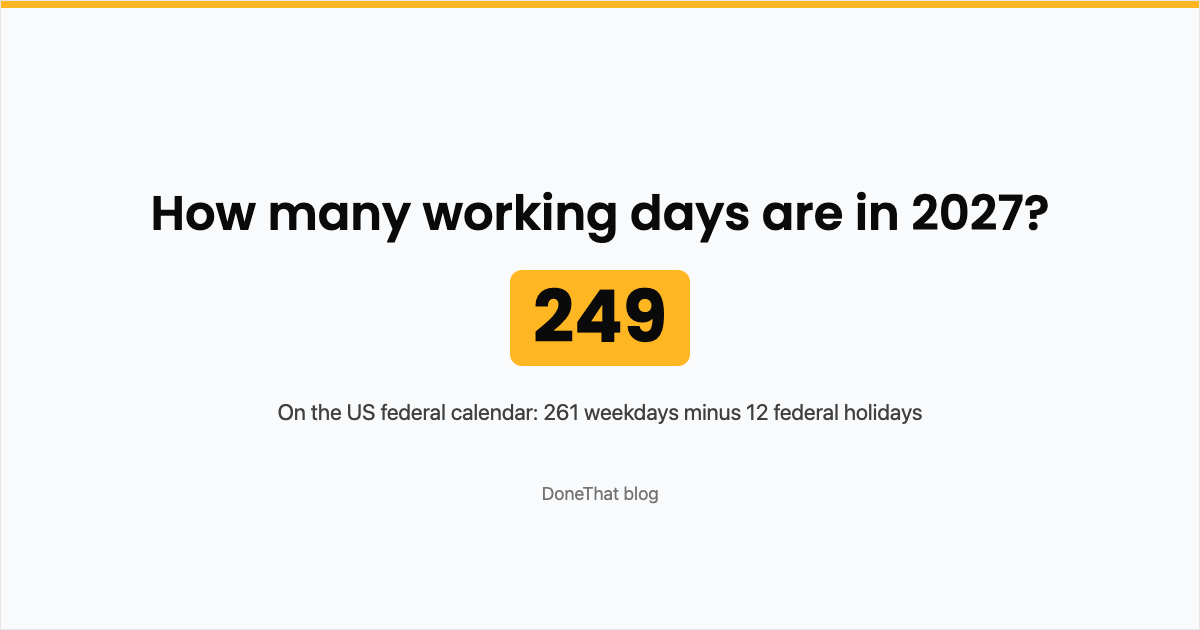
2027 has 261 weekdays and 249 working days on the US federal calendar, or 250 if your employer does not give December 31 off. Totals per quarter, the 2027 federal holidays, weekend rules and how 2027 compares with 2026.